

Notes for hoteliers
Upselling and cross-selling at a small hotel: what to sell and when
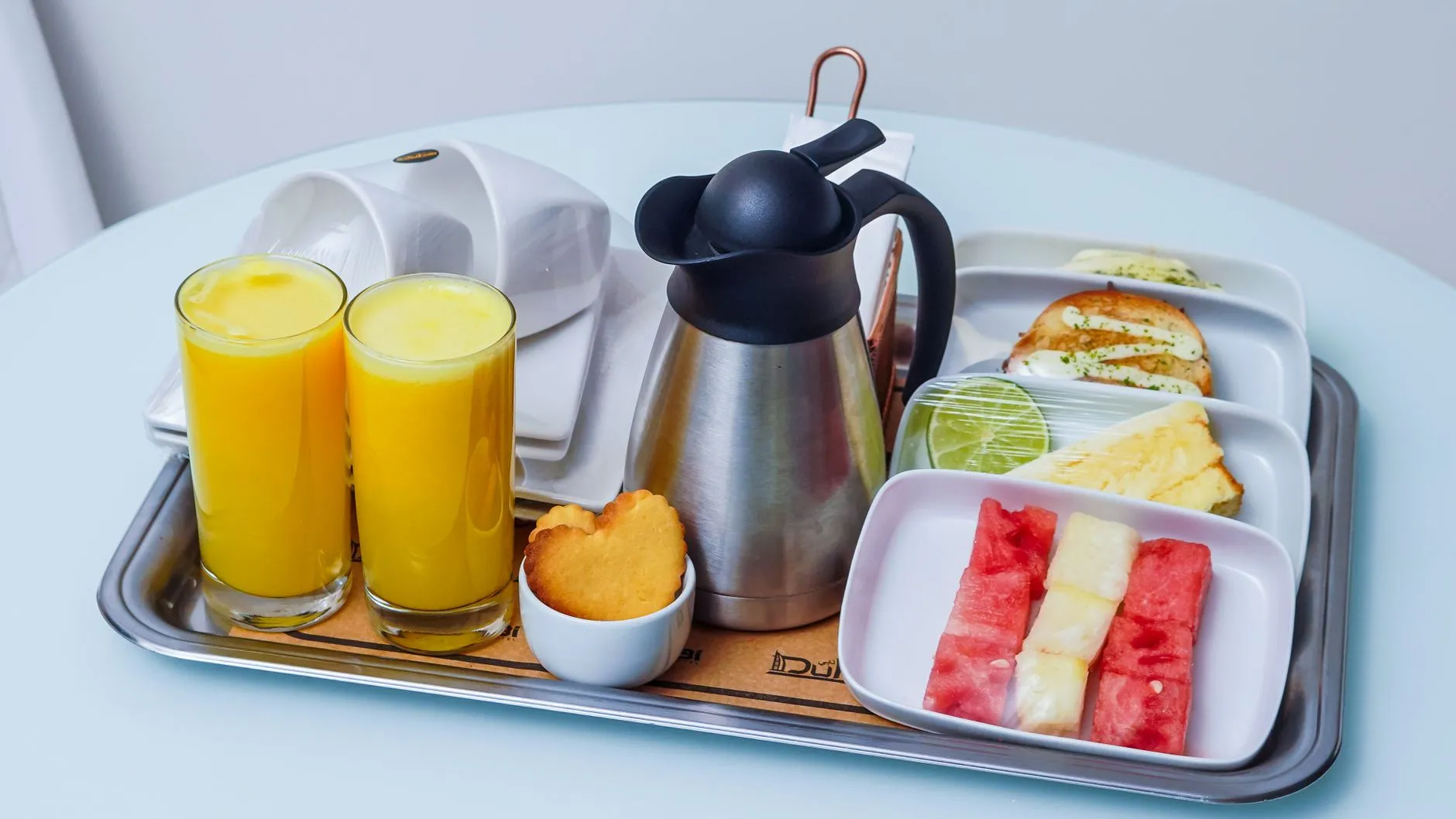
pedro furtado / Pexels
Sunday, half past ten. A couple comes down from room 208 with their suitcases — evening flight. Room 208 isn’t needed again today; tomorrow brings a family of three. The front desk of a twelve-room hotel says the usual “checkout at 11?” and gets a tired “could we stay a bit later?” — and right there, on that second, it usually ends as a free favor. Although this is the cheapest sale of the week: four extra hours in a room that would sit empty anyway.
That is what extra sales at a small hotel look like. The money sits in moments nobody counts as sales. A year-long sample of 4,729 paid upsells across a couple dozen small properties showed: early check-in and late checkout brought in 90% of all upsell revenue and 96% of the purchases. Not suite upgrades, not spa programs — two time-based services a small hotel sells without a single new expense.
Below: what upselling and cross-selling actually mean and how an upgrade differs from both; which extras really sell at a 9–30 room property; when to offer (timing matters more than the pitch); and how to price it. With numbers for every claim.
Upselling, cross-selling, upgrading: three different moves
Upselling is selling a more expensive version of what the guest already chose. Cross-selling is selling something the guest didn’t choose: a service alongside the booking. Booked a standard room? Offering the category above for a surcharge — upselling. Offering breakfast, a transfer, or late checkout on that same booking — cross-selling.
| Move | Example | What it moves |
|---|---|---|
| Upsell | “The standard is full — there’s a panoramic one floor up, €25 a night more” | average rate (ADR) |
| Cross-sell | “You can add breakfasts for both mornings to this booking” | revenue per guest |
| Upgrade | moving a returning guest to a better room, free | loyalty, reviews |
The third word people mix into this pair is a room upgrade: moving the guest to a higher category. Paid, it’s a special case of upselling; free, it’s a service tool — a compliment to a returning guest, a birthday gesture, a fix for a maintenance issue. A free upgrade isn’t a sale at all: it works on reviews, repeat visits, word of mouth. At a small property it is sometimes worth more than the paid kind.
This isn’t terminology for its own sake. The three moves land in different lines of your reports: upselling lifts the average rate, cross-selling lifts revenue per guest — and both stay outside ADR (breakfast never lands in ADR — the metrics breakdown is here).
Four reasons a small hotel needs extra sales
First: money that’s already close. At full-service hotels, everything beyond the rooms brings a fifth to a third of revenue — EHL industry estimates; conservative benchmarks put it at 10–20%. The guest is already acquired, the channel is already paid: an extra sale spends neither ads nor commission. CBRE’s operating database (2,669 US hotels) shows food and beverage per occupied room grew 3.8% in the first half of 2025 while room revenue grew just 0.8%: extras are growing faster than lodging itself.
Second: guest experience, when the offer fits. A guest offered breakfast at the right hour and a transfer for an early flight remembers “they thought about me,” not “they sold to me.” TripAdvisor’s survey: 91% of guests prefer having breakfast at the hotel, and for 65% breakfast influences which hotel they pick. Selling people what they already wanted isn’t aggression — it’s service.
Third: reviews don’t suffer. The fear of “pestering guests and getting three stars” isn’t supported by data: across 40,590 stays, guests who bought an extra left five stars in 76.7% of cases versus 75.5% for everyone else. The difference sits within the margin of error; the study’s own authors call it “no harm, not a lift.” As long as the offer is relevant and one at a time.
Fourth: capacity that otherwise idles. The breakfast room gets cleaned whether four tables or twelve are used; the kitchen runs in the morning anyway; your guests’ taxi to the airport drives off with or without you. The flip side of the same logic: not everything sellable should be sold. The minibar, for instance, brings 0.2% of F&B revenue with the biggest restocking and write-off headache of the whole department — it has no place in a small hotel’s priorities.
What to sell: the extras catalog of a small hotel
Start from data, not imagination. What guests at small properties actually buy, in descending order:
- Late checkout and early check-in. The two most time-bound services and nearly all of the upsell revenue (90% of the money, 96% of the sales — see above). Demand is confirmed by survey: 47% of guests would want late checkout, 44% early check-in.
- Breakfast. The best-selling upsell at online check-in; segmented offers to families convert at 25–30% versus 8–12% for solo business travelers.
- Transfer. An early flight, a late arrival, kids with suitcases — an offer attached to the booking solves it before the trip.
- Parking. Either it’s included (and then it’s a selling point) or it’s a guaranteed slot — both beat uncertainty.
- Spa and time-slot services. A massage, a sauna, a tour with a local guide — a small hotel rarely runs its own, but a partnership with the spa next door turns someone else’s resource into your extra. The scheme is simple: the neighbor gives you rates 20–30% below public, you sell at your price and keep the difference; for the guest it’s a sauna a step away, no calls in a foreign language. One contract, one line in your services catalog — and the hotel gained a whole category it doesn’t own.
- Category upgrades. Glamorous in slide decks, rare in life: in the year-long sample of small properties — 43 upgrade sales out of 4,729 extras. Sell it, sure, but don’t build the plan on it: the receptionist’s time is worth more than this category earns.
Then the things a small hotel shouldn’t have at all. A staffed spa, a tour desk, ski rental — each is a separate business with its own economics; adding them to your cost structure for the sake of an “extras package” is buying yourself a second job.
Last on the list, but not least: a public price list. A simple “service — price — how to order” table on the website removes half the negotiation: a guest who sees “late checkout — €25” says yes faster than one who must ask and hear the price out loud. A price list for extras is the same storefront as your room rates.
The economics of an extra: a 12-room calculation
Let’s count honestly, on a model property: 12 rooms, average rate €90, 65% occupancy — about 2,847 nights a year. Nothing exotic in the catalog: breakfast, late checkout, early check-in, transfer, parking.
The pricing formula for time-based services is 20–25% of the daily rate, rounded: at €90 that’s €20–25 for early check-in or late checkout. The most common upsell price in small-operator data is $50, but that’s a market where rates are twice yours; anchoring to your own rate is more honest.
| Service | Price | Sales/month | Revenue/month | Cost |
|---|---|---|---|---|
| Late checkout | €25 | 12 | €300 | near zero: the room sits empty anyway |
| Early check-in | €20 | 10 | €200 | near zero: cleaned the night before |
| Breakfasts on room-only bookings | €12 | 40 portions | €480 | ~40% food cost |
| Transfer (partner) | €30 | 6 | €180 | ~50% to the partner |
| Total | 300 + 200 + 480 + 180 = €1,160/mo |
A model calculation (12 rooms, €90 rate, 65% occupancy); the 20–25%-of-rate pricing formula — from a guest-messaging platform’s data (4,729 upsells, ~24 small properties, twelve months to July 2026). Accurate as of 10 November 2026.
The key line isn’t the total — it’s the cost column. €1,160 a month is about €14,000 a year, and the margin on the time-based services is close to a hundred percent: the room exists, it’s cleaned, the guest is already here. For comparison: to add the same €14,000 in room revenue at 65% occupancy you’d sell ~155 more nights — almost a month and a half of the whole hotel’s work.
Breakfast is the only line with honest costs in this table — and still worth it. A €12 portion at ~40% food cost leaves the hotel roughly €7; forty portions a month is €290 of margin. But the money isn’t the point: breakfast is the extra that sells the hotel itself. For 65% of guests it influences the choice of where to stay, and a morning dining room with four of twelve tables occupied looks better — on the bill and in the review — than one with two. The economics of an extra isn’t always measured by its own line in the table.
The partner transfer line tells the same story: half the price goes to the driver, but the hotel earns more than its €90. A guest met at the airport doesn’t go looking for the hotel across the street next trip.
Chains are making the same move at scale: since 2026, Hilton has sold confirmed late checkout for $40–60 across all its brands — confirmed up to 72 hours ahead, capped at 10–20 rooms per property. The chain counted the same thing you just did: tonight’s idle evening is an asset.
When to offer: the map of touchpoints along the guest journey
The same upsell sells differently at different moments. A pre-arrival offer converts at 12–22%; the same service at the desk, 3–7%: a fourfold difference, and all of it is timing.
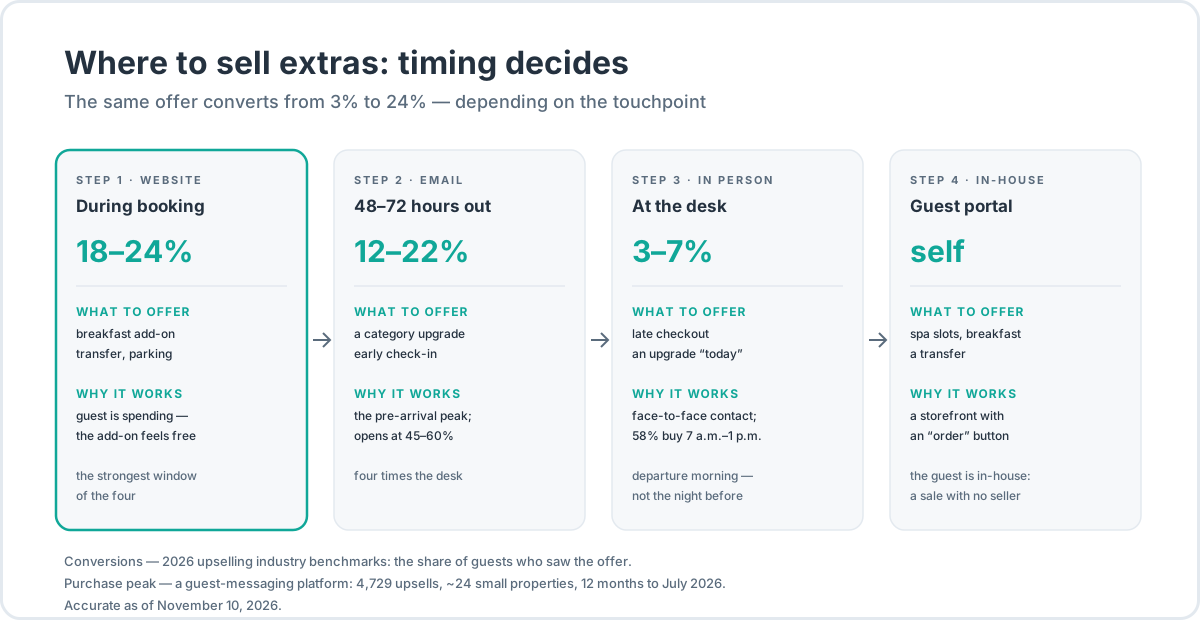
During booking. Offers inside or right after the booking flow convert at 18–24% — one of the strongest windows there is: the guest is already spending, the add-on feels “free” next to the total. Breakfast, transfer, parking — everything that makes sense to pick at once.
48–72 hours before arrival. The peak of pre-arrival conversion. The guest is thinking about the trip but not yet in transit; targeted emails in this window open at 45–60% versus ~20% for mass campaigns. Best candidates: an upgrade (your room availability is already visible), early check-in (flights are known), breakfasts.
At the front desk. Face to face converts worse (3–7%), but it’s free and personal. The window rule: 58% of all extra purchases happen between 7 a.m. and 1 p.m., early check-in peaks around 10 a.m., late checkout around 8 a.m. Offer late checkout on the morning of departure — not at eleven the night before; offer early check-in the evening before, or the morning of arrival day once the flight is known.
One more timing pattern that’s easy to miss: the booking’s lead time. In the same platform’s data, bookings made 31–60 days out buy an extra in 3.66% of cases versus 0.89% for same-day bookings. The planner plans and buys; the spontaneous one is already tired. For your mailing queue: the earlier the booking, the earlier the offer — long-lead bookings go first in the pre-arrival line.
In the Guest Portal — during the stay. The guest is already in the hotel: the portal they open to check their booking is a storefront of services with an “order” button. A 2023 UK snapshot of online check-in: 23% of guests checked in online, 3% of them bought an upsell at an average of £21 — modest, but these are sales that happened without a single question to staff.
Channels deserve their own word. Booking.com offers Room Upsell as part of the base commission, at no extra fee: the system automatically offers the guest an upgrade before arrival, and once accepted, returns the old room to inventory. The conditions are strict — at least two room categories, upgrades only to a pricier room with the same occupancy and bed setup, payment at the property. An honest tool, but keep the main point in mind: channel commission is paid on the room revenue, while an extra sold on your direct channel pays no commission at all. Direct bookings already bring in more — $516 on average versus $312 from a channel (the breakdown is in the Booking Engine guide) — and extra sales widen that gap.
Six tactics that work at the desk and in the email
Segment before you offer. Party composition is the main predictor: families convert on breakfast offers at 25–30%, solo business guests at 8–12%. Segmentation by rate and length of stay adds another 15–25% to conversion. A small hotel needs one or two rules: “families with kids get the breakfast email; arrivals on evening flights get early check-in.”
One offer per contact. Breakfast and an upgrade and a transfer in one email isn’t three offers — it’s zero: the guest chooses not to choose. “The main thing first, the second two days later” beats a five-service storefront in one screen.
Sell the delta, not the price. Not “the panoramic room is €115” but “for €25 on top of your booking — one floor up, with the view.” Same arithmetic, different psychology: the guest decides on a surcharge, not a new purchase. Working desk lines:
- “Evening flight? Keep the room till six for €25 — no luggage to drag around” (late checkout, departure morning);
- “Arriving at seven a.m.? The room is ready from the night before — early check-in for €20” (offer the night before);
- “Breakfasts for both mornings — €24 instead of €30 when added to the booking” (a pair is always cheaper than two singles);
- “The panoramic one floor up is open — €25 for both nights” (an upgrade priced as a delta).
Scarcity — only the real kind. “One category left above yours” works when it’s true — and at a 12-room hotel it almost always is. Invented scarcity guests read instantly and remember longer than the price.
The storefront must exist. Photos of the breakfast, the sauna, the panoramic view aren’t website decoration — they’re the top of the extras funnel: a guest doesn’t buy what they haven’t seen. The direct channel shows every category and every service; that’s exactly what it’s for.
Record what was sold. An extra sold but never entered into the booking is a refund and apologies on arrival day. An “add service” button on the booking is the same sale with a paper trail: the amount lands on the guest’s bill, not in the receptionist’s memory.
How this works in HotelsCalendar
The services catalog is shared between the Booking Engine and the Guest Portal. Each service carries its own pricing model; quantity-based services (breakfast, transfer, parking) are sold by the piece against a booking, time-slot services (spa, tours) sell as calendar slots with visible slot availability: the guest sees the 7 p.m. sauna is still open and books the exact hour.
From a booking card, a service is added on the “Extra services” tab — the price pulls from the catalog, the amount goes straight onto the guest’s bill. Early check-in and late checkout live in a separate mechanism: add-ons in occupancy variants, tied to the room category and party composition rather than the catalog.
The guest sees their services everywhere the booking appears: in the confirmation, in the portal — next to rooms, daily prices, and the balance due. Guests can order an extra from the portal themselves, no call to the desk — including mid-stay.
Honest limits: automatic upsell offers (“the system will offer the guest a paid upgrade by itself”) are not in the first version — pre-arrival offers are sent by the hotel’s own emails, and the storefront and buttons do the rest. The subscription includes everything above, with no separate “upsell module” tier: 14 days of full access.
The bottom line
Extra sales at a small hotel aren’t a million-euro spa or persuasion scripts. They’re early check-in, late checkout, breakfast, and a transfer, offered at the right moment: during booking or a couple of days before the trip, one offer per contact, at a quarter of the daily rate. The two time-based services bring 90% of upsell revenue — at almost no cost. Start with a five-line price list and one email 72 hours before arrival: that’s enough to lift a thousand euros a month from the property you already have.
Frequently asked questions
What’s the difference between upselling and cross-selling in plain words?
Upselling is the same purchase, but pricier and better: a room a category higher. Cross-selling is an additional purchase on the booking: breakfast, a transfer, late checkout. An upgrade is a special case of upselling when paid — and a service tool when free. More in the metrics guide: upselling moves ADR, cross-selling moves revenue per guest.
How much do hotels earn on extras?
At full-service properties, everything beyond rooms brings a fifth to a third of revenue; in the model calculation for a 12-room hotel, five basic services yield about €1,160 a month with margins near 100% on time-based services. How this fits the bigger revenue picture — in the revenue management guide.
What share of guests say yes to an extra?
Depends on the moment: a pre-arrival offer converts at 12–22%, at the desk 3–7%, an offer inside the booking flow at 18–24% (the share of guests who were offered). Across all bookings the paid-extra share is more modest — about 1.6%: not every booking gets an offer at all — the storefront in the Booking Engine raises that share on its own.
When to offer: at booking or at the desk?
At booking, or 48–72 hours before arrival: conversion is four times higher than at the desk, and targeted email opens at 45–60%. At the desk, mornings work: 58% of extra purchases happen between 7 a.m. and 1 p.m. Some guests see the services on their own — in the Guest Portal, without reminders.
How much should late checkout cost?
By the small-operator formula — 20–25% of the daily rate, rounded: at €90, that’s €20–25. The chains confirm the range: Hilton has sold confirmed late checkout for $40–60 across all brands since 2026. How to price off your own rate — in the room pricing guide; sell only into a room nobody needs again today.
Does Booking.com take commission on extra services?
Channel commission is charged on the room revenue in the booking; the built-in Room Upsell is offered at no extra fee — but only as an upgrade to a pricier room with the same occupancy, and not in every hotel (you need at least two categories). Extras sold on the direct channel pay no channel commission at all — why the direct channel pays more.
Which extras do guests buy most at a small hotel?
Late checkout and early check-in (90% of upsell revenue), then breakfast — especially for families (25–30% conversion), transfer, and parking. Upgrades are rare: 43 sales out of 4,729 extras in a year of small-property data. The top services go into the catalog once — how the storefront works.
Do I still need to train staff to sell if there’s a booking engine?
Yes, but less: the service storefront in the Booking Engine and Guest Portal sells on its own — guests add breakfast or a spa slot without the desk. Staff keeps segmentation (who gets which offer) and the in-the-moment desk sales — how the storefront is built.
What should be free for guests and what should be sold?
Free: what costs pennies and feels like care — water, tea, Wi-Fi, late checkout as a compliment to returning guests. Sold: what occupies a real resource — a time slot, a seat in the transfer, a breakfast portion. The line runs along cost, not greed; in the product the line is visible at once — paid items live in the catalog, and free requests guests send through the Guest Portal.
How do I format a price list for extra services?
As a “service — price — how to order” table right on the website: the guest must see the price before asking. For time-slot services list the slots (“spa sessions 10 a.m.–8 p.m., by appointment”), for check-in timing, give the formula (“late checkout — €25, subject to availability”). A public price list removes the negotiation — the services storefront works the same way.