



Notes for hoteliers
Hotel competitor analysis: how to pick your compset and compare rates

Tima Miroshnichenko / Pexels
Monday morning. The owner of a fourteen-room hotel opens Booking, types in her own street — and sees that the three-star next door has raised weekday rates by twenty euros. Below it, two more hotels haven’t touched their prices. Follow the raise? Hold? She has no idea what’s happening inside those buildings — and the decision is due before lunch.
This is the moment competitor analysis is actually made. A survey of 450 hoteliers in the fall of 2026 showed that 43% of hotels still run without any pricing system — 29% live on spreadsheets and last year’s rates, 14% set prices by feel. Those who do look around do it deliberately: the right set of competitors and ten minutes of comparison a day gives you the market picture that industry services charge €180–400 a month for.
Below: what a compset is and who goes into it, how to capture competitors’ rates for free (and why you’ll have to check channel by channel), what the resulting table looks like, and how often to revisit all of it. No paid tools — by hand, an hour to start and ten minutes a day.
What a compset is and why a small hotel needs one
A compset (competitive set) is four to eight hotels that the guest compares you against at the moment of choice. Not every hotel in the district and not the ones the owner admires — the ones your guest genuinely wavers between. The key to the set is simple: put yourself in the buyer’s shoes. What opens next to your card on Booking, what Google Hotels shows within your price filter, between what and what does the guest choose.
It helps to separate direct and indirect competitors. Direct ones are those the guest drops into the same comparison as you: same price, same product, same place. Indirect ones are alternatives of a different kind: if you’re a 20-room city hotel, apartment listings or a guesthouse on the edge are indirect competitors — on an ordinary Tuesday the guest isn’t choosing between you, but on long holidays or a tight budget, suddenly they are. Indirect competitors don’t belong in the table: keep them in peripheral vision, once a season — checking whether guest behavior has shifted enough to make an “indirect” competitor direct.
Industry benchmarking runs on the same sets: by STR benchmarking rules, a competitive set needs at least four hotels, of which at least three are independent of each other. Fewer than four — and one discounting neighbor skews the whole average; more than eight to ten — the signal drowns in noise. Hence the working size for a small property: four to eight hotels, and four or five nearest in spirit are enough to start.
Why a small hotel needs this — not a “trendy RM process,” but three everyday gains. First, you stop pricing in a vacuum — “the neighbor raised by twenty” turns from a trigger into one row of a table. Second, you see your windows: where you’re cheaper at the same quality (money on the table), and where you’re pricier for no reason. Third, you notice market shifts before they reach your occupancy — revenue management starts exactly with this look outward.
And don’t dismiss the “soft” data: reviews, ratings, guest questions — this is the public layer of quality that the industry pays for in expensive reports. EHL advises small properties not to ignore qualitative sources: reviews and OTA ratings give the same picture of perceived quality as paid panels, just gathered by your own hands. Your table will beat any dashboard for one simple reason — you know your neighborhood better than any algorithm.
And the honest disclaimer right away: knowing their prices is half the job — the decision is still yours. Blindly copying the neighbor is the fastest way to start a price war both of you lose.
How to pick competitors: five filters
Building the set is the only stage worth an hour of hands-on work on every candidate. Five filters, from hard to soft:
Location. The radius depends on the format: for a city hotel it’s “the same part of downtown and the same 10–15 minute walk to the main spots”; for a country property — “the same direction and the same approach time.” The guest filters by the map — filter by the map too.
Price tier. The guest compares what lands in one price filter. If your average rate is €90 and the neighbor’s is €140, you’re almost certainly not in one set, whatever your stars say. The benchmark: a close rate range on the same dates.
Type and style. Formally — stars and size. Really — comparable impression: an 18-room boutique and a 150-room business hotel aren’t competitors even side by side. A family guest house doesn’t join a set with a designer hotel for couples.
Offer. Rooms of the same caliber, breakfast or none, parking, spa — not a perfect match, but several shared points. If a competitor’s product is fundamentally different, comparing rates means comparing apples to oranges.
Who travels and why. Guest segments: families on weekends, business travelers midweek, couples on city breaks. A competitor is the one intercepting your own guest — not everyone’s.
A practical candidate check takes five minutes. Open the map around your hotel and list everything within your radius and price filter — usually eight to twelve candidates. Then the cut: two control dates (the nearest Saturday and an ordinary Tuesday two weeks out), the same room type, a look at ratings and the makeup of services. Whoever passes goes into the table; whoever matched only on geography but lives in another price tier is out. By evening you have a working set — and it will be more honest than any ready-made list from a service, because you’ve just walked your guest’s path.
One more temptation, the biggest one: don’t put the hotel you aspire to be into the set if it isn’t your competitor. Industry practice distinguishes a working set from an aspirational one: the first is for daily decisions, the second — “a tier above,” for seeing the market ceiling. Average the aspirational into the working one, and every benchmark will whisper “you’re cheap” while the guest simply never compares you. Want a role model — keep it as a separate “sample” line, outside the averages.
Where to look at competitors’ rates for free
A paid rate shopper captures competitor rates automatically — and starts around €180 per property per month at public prices. A small hotel doesn’t need one to start: everything the guest sees, you can see too.
OTA channels. Booking and Airbnb show competitor rates right in the results for your location. Look from an incognito window (personalized discounts and cookies skew the picture) and note the rate for the same room type.
Metasearch. Google Hotels stacks channel offers on top of each other — a free showcase of the whole market for one date: who stands where in each channel, who carries the “deal” badge. Ranking in that window isn’t for sale — you see the market roughly the way the guest sees it.
Your own direct channel. Don’t forget the main mirror: competitor rates only mean something next to your own — your rate grid lives in your rates, and that’s what you compare against.
And an honest note on the blind spot: the manual round sees the public layer of the market. Corporate rates, closed groups, net rates to operators and partner pools stay invisible — as they do for paid tools, by the way. It doesn’t break the method: you compare what the guest sees, and the guest decides on exactly that layer.
And one piece of news that made the manual round matter more: since December 2024, Booking.com dropped rate parity conditions for European partners — the price on your site no longer has to repeat the channel’s price, and the parity reports in the extranet became “purely informative.” The practical consequence: the same room at the same competitor can cost differently across channels — and that’s not a bug. A consumer experiment (40 hotels, 6 channels, 30 days of observation) recorded an average spread of 18% between the cheapest and the most expensive site for the same room — median 14%, maximum 47%. On top of that, member rates average 8–12% below public ones — a guest in a loyalty program sees a different market than you do. An academic check across 200 London hotels confirms it: the “law of one price” doesn’t hold in the hotel market. So channel by channel isn’t paranoia — it’s method.
The comparison table: what to capture and what to write
The whole method fits into one table. Rows — the competitors and you; columns — the parameters. Make a sheet in any editor and fill it by the rule of three matches: the same date, the same room type, the same window — otherwise you’re comparing the incomparable (the same rule — in the rate pricing guide).
Take two snapshots a week out: one for Friday–Saturday, one for Wednesday–Thursday. A hotel’s peak and weekday prices are two different decisions, and you need to see both. Snapshot depth — at least two weeks: by an industry report across 90 million bookings, the booking window of independent hotels runs about 40 days, meaning the nearest two weeks are already being compared by guests right now; you’ll pick up the far horizon closer to the season. Fix the capture time: rates are alive, and comparing yesterday’s with today’s means comparing different markets. And keep the method identical from run to run — one source, one time, one browser mode: the table only means something if every row was captured the same way.
| Competitor | Fri–Sat, standard | Wed–Thu, standard | Min stay | Breakfast | Cancellation | Rating |
|---|---|---|---|---|---|---|
| You | €105 | €80 | — | +€12 | flexible | 8.7 |
| Hotel A (across the road) | €110 | €79 | 2 nights Fri | included | flexible | 8.9 |
| Hotel B (on the waterfront) | €130 | €95 | — | included | non-refundable | 8.6 |
| Guesthouse C | €85 | €70 | — | none | flexible | 9.1 |
| Hotel D (by the station) | €98 | €75 | — | +€10 | flexible | 8.2 |
A model table (four competitors, the “one week out” snapshot); capture rules — same date, room type, window, incognito mode. The format and columns are a working template; the numbers are illustrative.
What to record beyond the rate — the things the guest actually pays extra for or gives up: minimum stay on peak dates (stop-sell and restrictions are their own story), breakfast included or paid, cancellation flexibility, rating and review count. The last column often turns out to be the most important: a 9.1 guesthouse rating explains why it isn’t afraid to price above its “star level.”
The price-quality map: what to do with the table
When the table is filled, you have two rows of numbers: the average rate and the average rating (from open review sources — the same data the industry pays for, just captured by hand). Plot them on two axes — price horizontally, rating vertically — and place the dots: yourself and the competitors.
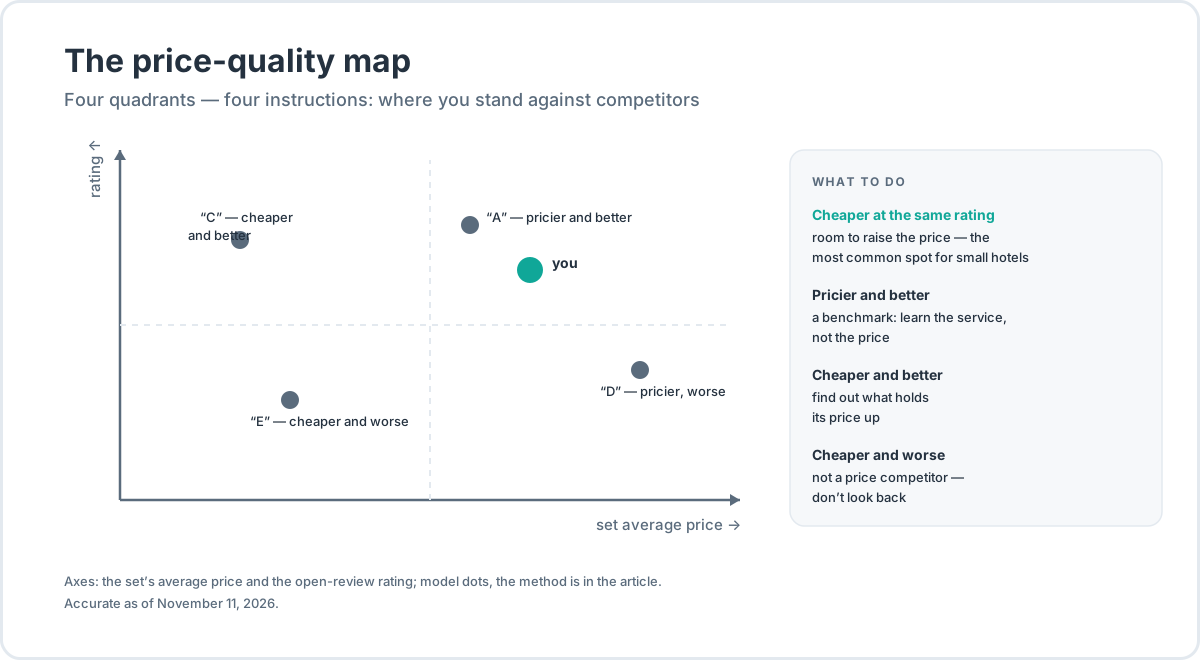
The four quadrants read as instructions. Pricier and better than you — a benchmark: learn from its service, not its price. Cheaper and worse — not your competitor in pricing decisions; ignore. Cheaper and better — alarm: someone is saving on what your guests pay you for; find out what exactly holds their price up. And the most common window for a small hotel — you’re cheaper at the same rating: your price lags your value, which is an argument to raise the rate, not a reason to panic. Say your rating is 8.7 with breakfast at a surcharge and you hold €105 on a peak weekend, while the neighbor with equal reviews and breakfast included holds €110 — you have an honest €5–10 of headroom the market won’t punish. The reverse case — pricier at the same rating — means you’re selling thin air the guest will eventually notice.
The map doesn’t decide for you — it removes illusions. The decision stays yours: raise the price, add breakfast to the rate, or wait for the season.
The rhythm: ten minutes a day and a review twice a year
Regularity beats depth. The working rhythm of a small hotel: a short look daily, a full pass weekly, a set review twice a year.
The daily ten minutes — glance at the nearest 14–30 days across three to five dates: this short ritual is described in the revenue management guide, and the compset is its fuel. Competitor rates answer “how does the market see these dates”; your booking pace answers “what to do.” Neither works without the other.
The weekly pass — update the whole table: both snapshots, all columns, fresh ratings. The scenario is simple: Tuesday, half an hour, an incognito window, five table rows. First the peak dates of the coming weekend, then mid-next-week; right after — a quick scan of competitors’ reviews (fresh complaints about breakfast or housekeeping — an opening for your service) and their events: someone set a minimum stay on a holiday Saturday — the market expects a peak. Catch new hotels here too: a neighbor opened — a candidate for the set; one of the old ones lost its rating or repositioned — a candidate to leave. The average across your price column is a rough set ADR for the date (what ADR is and how to count it): your row above the average at the same rating is a signal, not a verdict.
Twice a year — rebuild the set from scratch through the five filters. Industry practice is unanimous in wording: a stale compset produces flattering but useless benchmarks — you’re comparing yourself to a past market. EHL recommends a quarterly review as the ideal; the minimum is at any significant change: a competitor opening, a renovation, a shift in your own positioning.
Three mistakes that undo the analysis
First — aspirational instead of working. The dream hotel in the daily table inflates the average, and every comparison whispers “you’re cheap.” The arithmetic is plain: if four honest competitors hold the peak Saturday at €100–115 and the “sample” at €160, its row pulls the set average up by dozens of euros — and suddenly your €105 looks like a discount, though the guest never compares you with the sample at all. The result is a systematically overheated price with occupancy below plan. Keep the sample on a separate line, outside the calculations.
Second — comparing the incomparable. Your standard against their studio, your breakfast-included rate against their room-only, your flexible cancellation against their non-refundable. Every such column is noise in the average. The rule of three matches exists exactly for this.
Third — capturing and never acting. A table for the table’s sake. The point of the snapshot is a decision: update the rate for the date, add a condition, hold. If ten sessions into the table nothing has changed in your system, you’re collecting numbers, not managing revenue. The loop is short: saw it — decided — wrote the decision next to the number (raised, holding, waiting) — checked next week what came of it. Three quarters of surveyed hoteliers are confident they maximize revenue; only 36% review their pricing strategy at least monthly. The gap between confidence and practice isn’t closed by a monitoring service — it’s closed by the habit of acting on data.
When the spreadsheet stops being enough
The set has grown, the dates have multiplied, you’re itching to automate — the industry will happily sell you a rate shopper with a mountain of data. Honest about the limits: monitoring services see public rates, not net rates after promos and corporate deals; they compare what their algorithms managed to match — and sometimes that’s your standard against their suite. Subscriptions for small properties start around €180 per property per month at public prices — over a year, a cost not every table earns back.
Our order of operations stays the same: saw the market price — made the decision — updated your rate and restrictions where everything else lives: in your rates, point-by-point for a date or in bulk for a period. When you’re managing not five competitors but a market — it’s time to read what software a small hotel actually needs.
The takeaway
Competitor analysis for a small hotel isn’t a €200-a-month service or a forty-page report. It’s four to eight properly chosen hotels, one table, two snapshots a week, and ten minutes of market-watching daily. Start today: list four neighbors through the five filters, put their rates for the coming weekend and Wednesday into the table — and on this very map you’ll see your quadrant. After that, it’s rhythm.
Frequently asked questions
What is a compset at a hotel in plain words?
A compset (competitive set) is four to eight hotels the guest chooses between instead of you: same location, same price tier, similar product and segments. By STR benchmarking rules — at least four hotels. Where the set fits into revenue strategy — in the revenue management guide.
How many hotels should a small property put in the set?
Four to eight. Fewer than four — one “odd” competitor skews the average; more than eight to ten — the signal washes out. Four or five nearest in spirit are enough to start — as in the daily ritual from the revenue guide.
How does a 9–30 room hotel choose competitors?
By five filters: location, a close price tier, type and style, offer makeup, guest segments. The key question for every candidate: “is this hotel intercepting my own guest?” — not “do I like it?” Checking your own rate against the set — in the rates guide.
How can I see competitor rates for free?
Through the showcases the guest sees: OTA results in an incognito window and metasearch — Google Hotels gathers channel rates in one window. Capture the same date, room type, and window — the rule of three matches from the pricing guide.
How often should I compare rates with competitors?
A short look at the nearest 14–30 days — daily (10 minutes); a full table pass — weekly; a set rebuild — twice a year, off-schedule at significant market changes. EHL recommends a quarterly review as the ideal — the rhythm is described in the revenue guide.
How do I compare my rate with a competitor’s correctly?
Three matches are mandatory: one date, one room type, one capture window. Plus comparable conditions: breakfast, cancellation flexibility, minimum stay — otherwise it’s comparing the incomparable. The method for checking your rate against competitors — in the room pricing guide.
What to compare in competitors beyond price?
Restrictions (minimum stay, stop-sells on dates — the restrictions breakdown is here), breakfast inclusion, cancellation flexibility, rating and review freshness. A rating often explains why a competitor can hold a price above its star level.
Does a 9–30 room hotel need a paid rate shopper?
Not at the start: a table and the showcases cover the whole working rhythm. Subscriptions start around €180 per property per month at public prices; the services see public rates, not net rates after promos and deals. When competitors and dates multiply — it’s time to talk software.
How is competitor analysis different from market analysis?
A compset is your four to eight direct substitutes in the guest’s eyes; the market is the whole supply pool, including formats you don’t compete with. Competitor analysis answers “how to price these dates”; market analysis answers “where we are at all.” The first is a daily tool, the second — the strategic frame of revenue management.
Can I benchmark against a hotel a class above?
You can — but only as an aspirational sample: watch the market ceiling and the service, never peg your daily price to it. Averaging the “dream” into the working set systematically inflates the benchmark and pushes you to overheat the rate — the market in your channel is seen more honestly.