


Notes for hoteliers
Revenue management in a hotel: where to start for a property with 10–30 rooms

RDNE Stock project / Pexels
July closed clean: all twelve rooms sold, the till reconciles. October on the calendar holds three bookings for the whole month. The price hasn’t moved since spring — €75 for a double, in July and in November, on a Wednesday and on a Saturday.
Formally, revenue management exists at a property like this. It’s just that nobody manages it: the price decision was made once, in spring, and hasn’t been revisited since. And a July Saturday and a November Wednesday are two different products — different people, different reasons to come, a different willingness to pay.
Here is what revenue management means for a 10–30 room property: no revenue department, no separate system, no promise to double your revenue. What to count, in what rhythm to look, which rules to build the price from — and in which cases the whole discipline pays back almost nothing.
Revenue management is decisions, not a purchase
The working definition from chain practice fits in one line: sell the right room, at the right price, at the right time, through the right channel, to the right guest. Five “rights” in a row sound obvious — until you check yourself against each one.
The logic came from the airlines of the 1980s. They noticed two things: a seat that flies empty is worth nothing — selling it at half price beats not selling it at all; and different passengers will pay different money for the same seat, not because someone is being fooled, but because their circumstances differ.
A hotel runs the same arithmetic with one correction that only makes it harder: a night that passed empty cannot be sold retroactively. The product is spoiled, and by morning you own a different date.
Hence a simpler definition, for a twelve-room property. Revenue management is the discipline of regular decisions: which price to set for which date, when to move it, whom to invite, whom to turn down on a discount. Not a program, not a report, not a job title — a sequence of decisions somebody has to make on a schedule.
Three words that blur together should be separated up front.
Revenue is what guests paid. Income is what stays of that money after the direct costs of selling: channel commissions, cleaning, laundry. Profit is what remains after fixed costs: salaries, insurance, repairs, taxes.
Revenue management works on the middle of the three levels. Its levers — the rate, segments, channels, sales restrictions — change not how much the guest paid, but how much of what was paid stays with you. A night at €95 in a channel with a commission of 20% brings €76; a night at €85 direct brings the full €85. The second looks humbler in a search result and richer in the till.
Lastly: in advertising, revenue management often looks like a program feature — install the software, receive the revenue. At 10–30 rooms nearly all of the effect comes from decisions a human makes; software is for keeping the data those decisions rest on in one place. More on that at the end.
The price of doing nothing — and its limits
2025 produced a picture rare in its clarity. Per an industry report (the fourth annual edition on independent properties, 90 million bookings), independents slid over the year on average: occupancy −0.6%, average rate −5.8%, RevPAR −5.4%. The market as a whole barely moved: by the final revision of the CoStar and Tourism Economics forecast, US hotel RevPAR edged down 0.4%.
These numbers can’t be compared head-on — different bases, different geographies. The direction is visible: independents were losing faster than the market.
And yet the same year showed the opposite. Per the Boutique Hotel Report 2026, American boutique hotels — mostly independent and small — beat comparable traditional hotels on every main metric: revenue +4.2% against −1.7%, average rate $258 against $192.
The difference between the two groups isn’t size and isn’t the software budget. It’s positioning, a price of your own instead of the default one, direct bookings instead of expensive channel ones. In a word, discipline: some properties manage price, segments and channels; others let them live as they live.
Expectations deserve calibrating in advance. “Adopt revenue management and grow at least ten percent” is a marketing formulation with no methodology behind it. Training courses promise less: single-digit percentages of revenue, typically 3–7%, much of it landing almost straight in profit, because little is spent earning it. On a property turning over, say, €400,000 a year, five percent is €20,000. Vendor claims of “+18% RevPAR” and cases of “+40% revenue” are advertising for a specific product, not a market norm.
The first month: five steps
The discipline is set up in a month, with no purchases. Five steps — one per week, the last one runs in parallel.
1. Three numbers, by hand
Occupancy, ADR and RevPAR. The formulas, typical mistakes and examples are in the ADR article; here, only the role each plays.
Occupancy answers “how much of the inventory is sold,” ADR answers “at what price a sold night left.” RevPAR is what every room in the inventory earned, empty ones included, computed by multiplication: ADR × occupancy. One number without the other is half a diagnosis; the product is the metric revenue management checks itself against.
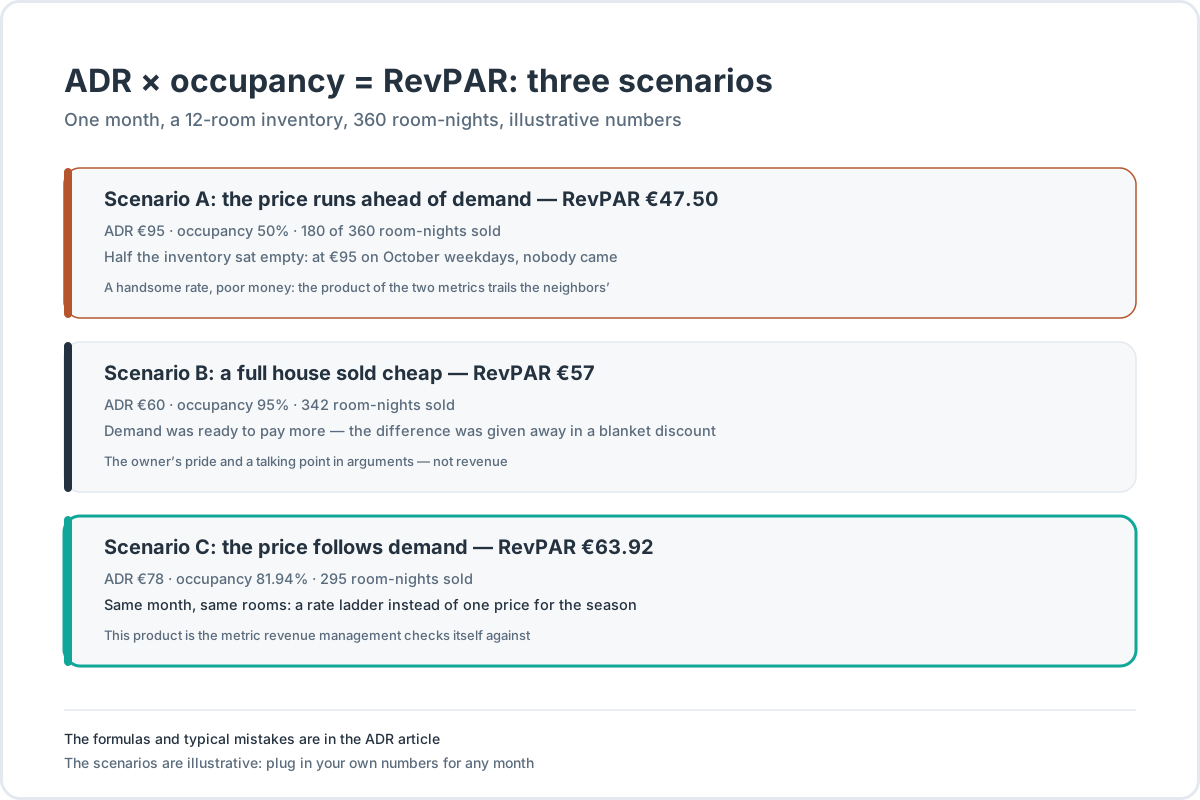
A PMS for a small hotel ships with no ready analytics — not a flaw, a matter of size. The raw data is there: amounts on bookings, sold and available room-nights; the spreadsheet arithmetic takes ten minutes a month. Bookings export to CSV for a period with a channel filter, so sold nights don’t have to be gathered by hand, by day and room type.
2. The floor rate
The line below which a night is not sold. It is calculated not from the revenue you’d like but from the cost of an occupied room: cleaning, laundry, consumables, channel commission — plus a minimum margin. The full calculation with an example is in the article on pricing a room.
Its one role in the discipline: a discount becomes a decision, not a slip. A night that costs you €12 and must earn €20, sold at €35 in a channel with a commission of 20%, brings €16 — four euros below target. At least you see it in the numbers, not at the end of the season.
3. A base grid for the season
Not 365 different prices, but three or four values: high season, middle, low — and weekends separately, because at most properties weekdays and weekends run as two different economies. The grid goes up for the whole season in one operation, then gets adjusted, not retyped.
4. Two to four segments
Who actually arrives: business guests for two weekday nights, families for two August weeks, couples for weekends, groups around a specific event. Each has its own booking window, length of stay and willingness to pay. For each — its own rate plan with conditions, not a blanket discount on everything.
Here is what such a set looks like (a conditional example, for a 12-room city property):
| Segment | Booking window | Length of stay | Instrument |
|---|---|---|---|
| Business guests, weekdays | 3–10 days | 1–2 nights | Weekday rate, late check-out as a paid extra |
| Families in August | 1–3 months | 5–10 nights | Early booking, a package with breakfast |
| Couples on weekends | 1–3 weeks | 2 nights | Two-night minimum stay, a non-refundable rate |
| A group around an event | 2–6 months | 2–3 nights | A higher rate on event dates, closed to arrival |
The numbers in the table are a template, not statistics: fill them with last season’s data and you get a list of rate plans for the next one.
5. An events calendar
One list for the year: what happens in town, month by month — concerts, conferences, holidays, school breaks, fairs. These are the most predictable high-demand dates: they are known weeks and months in advance, while the rest of demand shows up only in booking pace.
The booking window at independent properties has lengthened over the past few years: in 2025 it averaged 40 days against 38 two years earlier, and 47 days in EMEA (an industry report). The practical conclusion: the plan is visible roughly a month ahead, and a calendar date needs closing off with a price in advance — not in the week of arrival.
A weekly rhythm instead of a department
In chains, dedicated people handle revenue management. At 10–30 rooms, a rhythm replaces them — not a metaphor, but market practice compressed to owner scale.
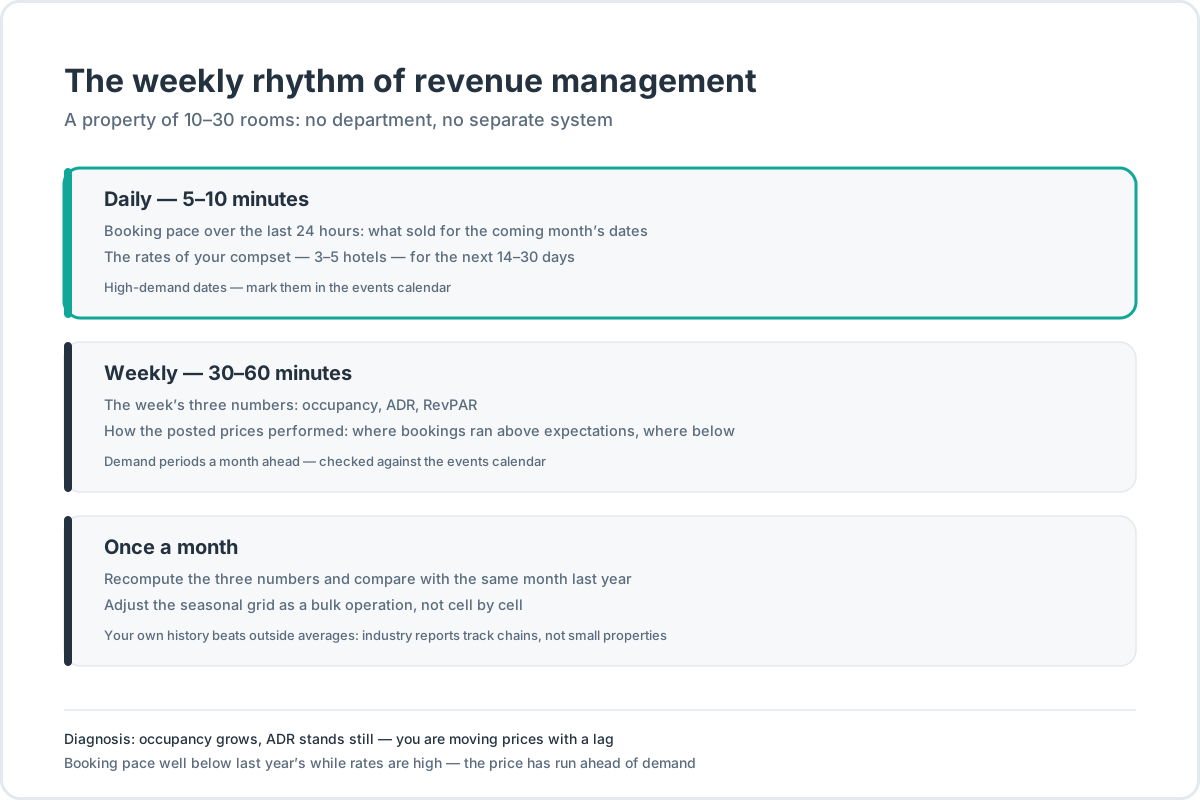
Daily, 5–10 minutes. Booking pace over the last 24 hours across the coming month’s dates, the rates of your compset — three to five comparable hotels — for the next 14–30 days, notes on high-demand dates. Everything visible without reports: how much sold overnight, and what the neighbors are doing.
Weekly, 30–60 minutes. The week’s three numbers, and a review of how the posted prices performed: where bookings ran above expectations, where below. Plus the demand periods a month ahead, checked against the events calendar.
Once a month. Recompute the three numbers, compare against the same month last year, and adjust the seasonal grid — as a bulk operation, not cell by cell.
The comparison with last year is a small property’s main reference: it’s the only comparison where you control both sides. A manual check against competitors is the second reference, but not a replacement: their rate depends on their costs, service package and strategy — none of which you know.
Two pairings diagnose faster than any analytics.
Occupancy is growing, ADR is standing still. You are moving prices with a lag: demand is ready to pay more, and the rate is still last week’s.
Booking pace is noticeably below last year’s — by a fifth, say — while rates are high. The price has run ahead of demand. No need to cut at once: first check you’re comparing like periods, then look at the channels. How to read booking pace on future dates at all — in the article on the OTB index.
Why one price for everyone is lost money
The textbook example every book on the subject starts with. You have 10 rooms and 10 guests, each willing to pay €100. Every room sells at the maximum price. This situation does not exist.
Reality looks like this: five are ready to pay 100, three at 90, two at 80. One price for everyone means five rooms sold and €500. Three prices — 100, 90 and 80 — deliver a full house and €930: everyone pays at their own willingness.
The difference isn’t cunning but a plain fact: every guest has their own willingness to pay, their own ceiling above which they walk to the neighbor. A €90 rate isn’t a “markdown” — it’s a different product for a different segment.
Textbooks put “price elasticity” next to this, and care is needed: even industry blogs mix the terms up. Elasticity is how strongly demand responds to a price change. The rate rises 5% — from €100 to €105 — and demand falls 10%: elasticity equals two, demand is elastic. Willingness to pay is something else: the specific ceiling of a specific guest. Elasticity is worked at the level of segments and seasons; willingness to pay, at the level of the rate ladder.
The practical conclusion is the same in any language. Different guests, different sensitivity: a weekday business guest pays from an expense account and books a week out; an August family pays from the family budget and books half a year ahead; a weekend couple compares a dozen offers in a search row. One rate for everyone simultaneously undercharges the first group and hands the second to the neighbors.
And the last thing forgotten when people say “take the maximum from everyone”: the guest isn’t buying a rate, but what they get for the money. A room can’t be touched before arrival, so photographs, description, layout and reviews do the deciding. A strong room type page is part of pricing work, not “marketing over there”: the same rate with a clear description and honest photos convinces better than a discount on a weak page. What the guest sees on the shelf — in the Booking Engine article.
Steps instead of a single price list
One price list for the season loses in both directions: in the high season you give rooms away below what the market will pay, and in the low one you hold a price nobody comes for. The revenue management logic for a small property is steps that move by rules.
A guide for independent hotels by Duetto works through the case of a 40-room boutique. Without a strategy, the property was full by Thursday — at $180 a night, and nearly all bookings arrived through the cheapest channels. Competitors closed the same weekends at $220–260. With a stepped strategy, the same inventory sells differently: $180 for early bookings, $210 as they accumulate, $240 and up for the last rooms — plus priority for high-margin channels, so the remainder doesn’t drain into the costliest distribution.
The rules for the steps assemble from three parts.
The price rises as bookings accumulate. Not “because it’s the season,” but because demand has confirmed itself: five rooms of a room type sold is a signal that the next ones can sell higher. The reverse rule works in the low season: a week with no bookings is data too.
The same thing at the scale of twelve rooms. A high-season Saturday, base price €95, eight rooms open in the room type. The stepping rule reads: four sold — the rate goes to €105; six sold — €120; two left — €120 plus a two-night minimum stay, so a short Friday doesn’t eat the expensive Saturday. If nothing has sold by Wednesday, that’s not a reason to slash the price — it’s a reason to check pace against last year and look at what the channels are doing.
Sales restrictions are the second lever, next to price. A minimum stay at the peak, so a short night doesn’t eat its expensive neighbor. Closing arrivals on the most expensive days, so a guest doesn’t sleep one Saturday and leave an empty Friday behind. “Closed to OTAs” on the dates you want to sell direct. Restrictions sit next to prices and travel to the channels together with them — otherwise half the plan stays on paper.
Events are closed off in advance, by hand. The mechanics are the same for a big city and a small property. Per Lighthouse, on the concert days of Taylor Swift’s tour the average room price rose as high as +154% against the pre-tour weeks; at Coldplay concerts in Australia, occupancy ran up to +81% and the average rate to +61%. A five-hundred-seat city concert won’t hand you percentages like those, but the same thing in miniature: a date known in advance, on which demand arrives earlier and pays more. Raise a date like that in the price calendar at once — don’t wait for it to “build up on its own.”
The whole mechanics of the steps: a one-click rate edit for a date in the Price Manager, and a bulk update across a period with a “before → after” preview before applying. A grid for an event is one operation, not a hundred cell edits.
Channels: the demand is there, the economics differ
Channels bring independent properties most of their sales: 63.4% of bookings per an industry report for 2025. Ignoring them is not an option. Selling into them without looking isn’t either.
First: a channel’s economics are counted after commission, not before. The same night in two channels is different money, and comparing by the public rate means nothing.
Second: channels have a different cancellation profile. Per industry data, 21.8% of bookings arriving through OTAs get canceled, against 10.6% of direct ones. The average lead time before a cancellation has grown to 39 days — a freed room re-enters sale well in advance, and must be reassembled: back on sale, a different rate, a different channel.
Third: a direct guest is not “one more channel” — it’s a commission-free segment. Same room, same night, more income. Where commissions come from and what the guest pays the intermediary for — in the article on OTAs; how direct selling works — on the Booking Engine page.
Rates and availability are carried out to every channel by the Channel Manager: one source of rates instead of manual edits in three extranets.
RMS: the next level, not the first
An RMS (revenue management system) is a separate class of software above the PMS: it forecasts demand and moves rates on its own. The thesis “an RMS is unconditionally necessary” — the norm ten years ago — doesn’t work for a small property: at 12 rooms there is too little booking history for a forecast to learn from, and nobody to re-check the recommendations daily. The “from 10 rooms” threshold named by RMS vendors is a seller’s recommendation, not a rule of the market.
What stays true in the old formulation is the main thing: an RMS is useless without PMS data. Automation needs current and historical data on inventory, bookings and rates — the PMS collects it. And prices are published to the channels by the system the rate lives in, not a separate program. Industry materials put it plainly: an RMS detached from the PMS, the channels and the booking engine loses most of its power.
Hence a rollout order you rarely hear in advertising: first the data in one place, then the rules, then — if you feel like it — automation. Per an industry report for 2025, 67% of independent properties name disconnected systems as their main operational pain and lose one to two days a week reconciling data. Automation on top of disconnected data doesn’t help — it speeds up the confusion.
Honestly about us: HotelsCalendar has no RMS, no demand forecast, no automatic price recommendations. It has what a small property runs revenue management on by hand: bookings from every channel in one Planner, a day dashboard in absolute numbers (check-ins, check-outs, rooms free, bookings with a balance due), rate plans with restrictions, a price calendar with bulk updates. The occupancy, ADR and RevPAR formulas you compute over this data yourself — in a spreadsheet, by the formulas from the ADR article. How this set fits the property’s other software — in the article on software for a small hotel and on the PMS page.
AI in rates is from the same series. Industry surveys show: algorithms already forecast demand decently, but they work as an advisor — the machine proposes the rate, and the final decision on the event, the positioning and the floor stays with a human. For a small property this confirms the same order: data and discipline first, automation after.
When it pays off — and when it doesn’t
Revenue management is not a mandatory program for everyone. The effect appears where demand is uneven, and nearly vanishes where it’s even.
It most likely pays off if you have two clearly different seasons and the low one isn’t “a bit softer” but several times emptier; if the town has events that move demand onto specific dates; if weekdays and weekends work differently; if there are several channels, with different commissions; if occupancy drifts month to month.
It will give almost nothing if demand is even year-round, occupancy sits near 100%, and all of it arrives through one channel on contract. It won’t pay off on a five-room property either, where a single price is genuinely justified — there simply isn’t the volume of decisions.
Full occupancy, meanwhile, is not “no headroom” — it’s a separate topic. A steady one hundred percent means demand is systematically above supply at your price: someone is ready to pay more, and you’re giving that difference away as a discount. Plus full occupancy has an operational tail: nothing remains in reserve for repairs, a sudden double booking, or a guest who needs to move rooms.
Hence the honest answer to “where do I start.” Not with a purchase, but with a week of calculations: three numbers, a floor rate, a grid for the season, an events calendar — and a rhythm you can actually keep. Segments, channels and automation grow on top, once there’s at least a season of history.
Frequently asked questions
Does a 10–30 room property need a dedicated revenue manager?
No. At this size it’s one to two hours a week on the schedule from this article: five to ten minutes a day, half an hour to an hour for the weekly review, plus extra attention before events and at the turn of a season. What matters is different: the work needs one owner — the owner or the manager, not “everyone a little.” What a small property needs at all, and what not to buy — in the article on software for a small hotel.
What is an RMS, and does a small hotel need one?
An RMS is a separate program above the PMS: a demand forecast and automatic rate movement. At the start you don’t need one: the forecast has nothing to learn from, and there’s nobody to re-check the recommendations. What you need more is data in one place — bookings, rates, availability: without it, no tool works, an RMS included. What collects that data — on the PMS page.
How is revenue management different from rate management?
Price is one lever: the amount for a night, for a room type, on a date. Revenue management is working all the levers at once: rates, rate plans with conditions, segments, channels and their commissions, sales restrictions, the rhythm of review. A price can be managed within a single season; revenue management begins when the price is tied to occupancy, segments and the calendar. About the rate itself — in the article on pricing a room.
Which metrics should I track if the system has no ready analytics?
Four: occupancy, ADR, RevPAR and net ADR — after channel commissions are deducted. All are counted by hand with the formulas from the ADR article: room revenue, sold and available room-nights, amounts after commission. Once a month is enough; before events and at the turn of a season, more often.
Is revenue management about revenue or about profit?
About income: money after the direct costs of selling. A night at €95 in a channel with a commission of 20% brings €76; a night at €85 direct brings €85. That’s why channels are compared by net amounts, not by rate — and why a direct guest is worth more at the same price. Where commissions come from — in the article on OTAs.
Does revenue management always pay off?
No. With even year-round demand and near-full occupancy, the gain is small — and that’s normal. For everyone else, the realistic gain is single-digit percentages of revenue, and most of it goes straight to profit: the discipline costs almost nothing as long as you don’t buy a separate system for it. The cheapest start is three numbers, a floor rate and a seasonal grid; the rates and restrictions are edited in one place and travel out to the channels through the Channel Manager.