



Notes for hoteliers
ADR: what it is, how to calculate it and how to raise it

Kaboompics / Pexels
September is closed: twelve rooms, 240 nights sold, €18,000 in room revenue. Good month or weak? One more number decides. What price did those nights leave at — €55 or €95? The occupancy is identical either way. The business is not.
The answer is one line: ADR (the average rate) = room revenue ÷ nights sold. For the September above: €18,000 ÷ 240 = €75 per night — and with 67% occupancy that makes RevPAR €50. What follows is why the denominator breaks the number more often than the numerator, and where the rate earns more than volume does.
The number that pins this down is ADR (Average Daily Rate). In plain language, it is the average rate: what a sold night cost over the period. The metric is decades old and counted by properties of every size, yet it draws more confusion than any other figure in hospitality: it gets mixed up with the price on the website, divided by the whole inventory — and then the number won’t match the till.
Here is what ADR actually measures, how to calculate it without the classic mistakes, why it belongs next to occupancy and RevPAR (revenue per available room), and what raises it without costing you bookings.
ADR in plain words
ADR is the average price of a night you actually sold. Not the rate on your price list, not the “room from €85” on your site — the average across all nights sold in the period, discounts, promo codes, channel rates and upgrades included.
The gap between “price” and ADR shows up on three nights. Say the published rate is €85. One night sells at exactly that. A second goes for €60 — a promo code. A third for €95 — a weekend. The price on the site never moved: €85. The average across sold nights is €80. That is ADR: what a night earned, not what you asked for it.
Two practical consequences.
First: ADR is about nights, not guests. A guest paying €120 for two nights counts as €60 per night. “Average check” is a different metric with different jobs — keep them apart.
Second: ADR is an average, and averages hide detail. Two nights at €50 and one at €140 give the same ADR of €80 as three even nights at €80. So ADR is read in periods — month against month, season against season — never as one yearly number.
How ADR is calculated: the formula and an example
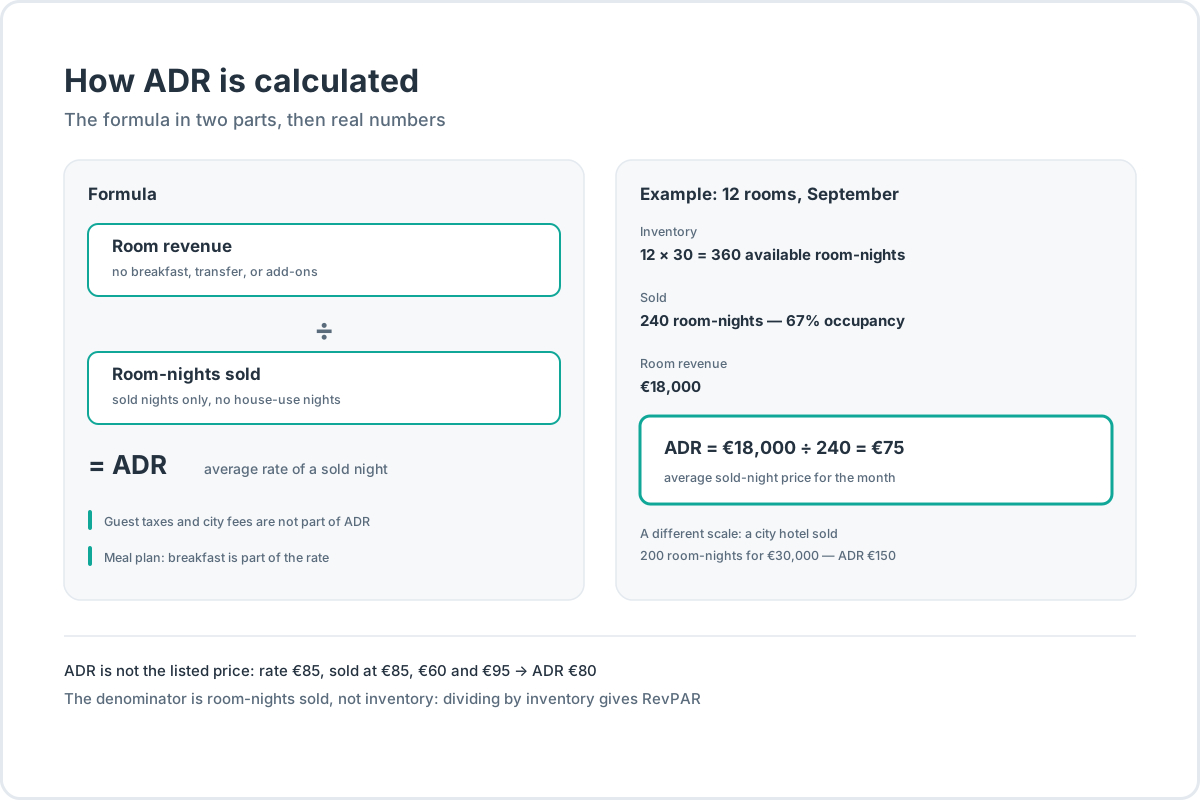
The formula is short:
ADR = room revenue ÷ number of room-nights sold
The denominator holds a word many owners haven’t come across: a room-night — one occupied night of one room. A 12-room property has at most 360 room-nights in September: 12 rooms × 30 days. If 240 sold, then 240 room-nights sold — not “240 rooms” and not “240 days.”
A worked example for a 12-room property (illustrative numbers):
| Line of the calculation | Formula | Value |
|---|---|---|
| Available room-nights | 12 rooms × 30 days | 360 |
| Nights sold | counted in the Planner | 240 |
| Occupancy | 240 ÷ 360 | 67% |
| Room revenue | till and payments for the month | €18,000 |
| Total: ADR | €18,000 ÷ 240 | €75 per night |
The same calculation at a different scale: a city hotel sold 200 room-nights and earned €30,000 — €30,000 ÷ 200 = €150 per night.
Run it for any period — month, quarter, season, year; by room type, booking source or rate plan. The base never changes: money from accommodation divided by nights sold.
Three mistakes that break the number
The formula is deceptively simple. Nearly all the difference between a trustworthy figure and a misleading one sits in three places.
Mistake 1. Dividing by all rooms
The most common one. The denominator must contain sold room-nights, not the whole inventory: €18,000 ÷ 360 gives €50 — but that is no longer ADR, it is a different metric (covered below). The number isn’t lying; it answers a different question.
The flip side is extra nights in the denominator. The receptionist slept in a room: that is a house-use night, no revenue. A room went out for repairs: it isn’t selling. A night was gifted to a fellow hotelier: complimentary. None of the three belongs in ADR — otherwise the average quietly slides down, unnoticed.
Mistake 2. Everything the guest paid, in the numerator
ADR takes room revenue. Breakfast, a transfer, the spa, a tour — none of it counts: other revenue lines. Blend them into the numerator and ADR stops showing your rate and starts showing the check — comparing it with anything becomes meaningless.
One exception: when the meal is baked into the rate (a “room + breakfast” package at one price), there is no honest way to split it — fine; breakfast then counts as part of the rate. The rule: pick one approach and keep it.
Taxes and city fees the guest pays on top are not the hotel’s revenue; they stay out of ADR.
Mistake 3. The method changes from month to month
In March you counted breakfast in, in April out. In May you forgot to drop the house-use night. Those months can’t be compared: the difference between them is not the market, it is arithmetic.
So: fix what goes into the numerator and the denominator, write it down in one line, and don’t touch it. If the method has to change, recalculate the past period under the new rules — otherwise comparison is pointless.
And a fourth one few people think about
The same ADR can mean different money. A night sold directly for €150 and the same night sold through a channel are €150 and about €120 in the till. That gets its own section, on net ADR.
Why ADR, if you already track occupancy
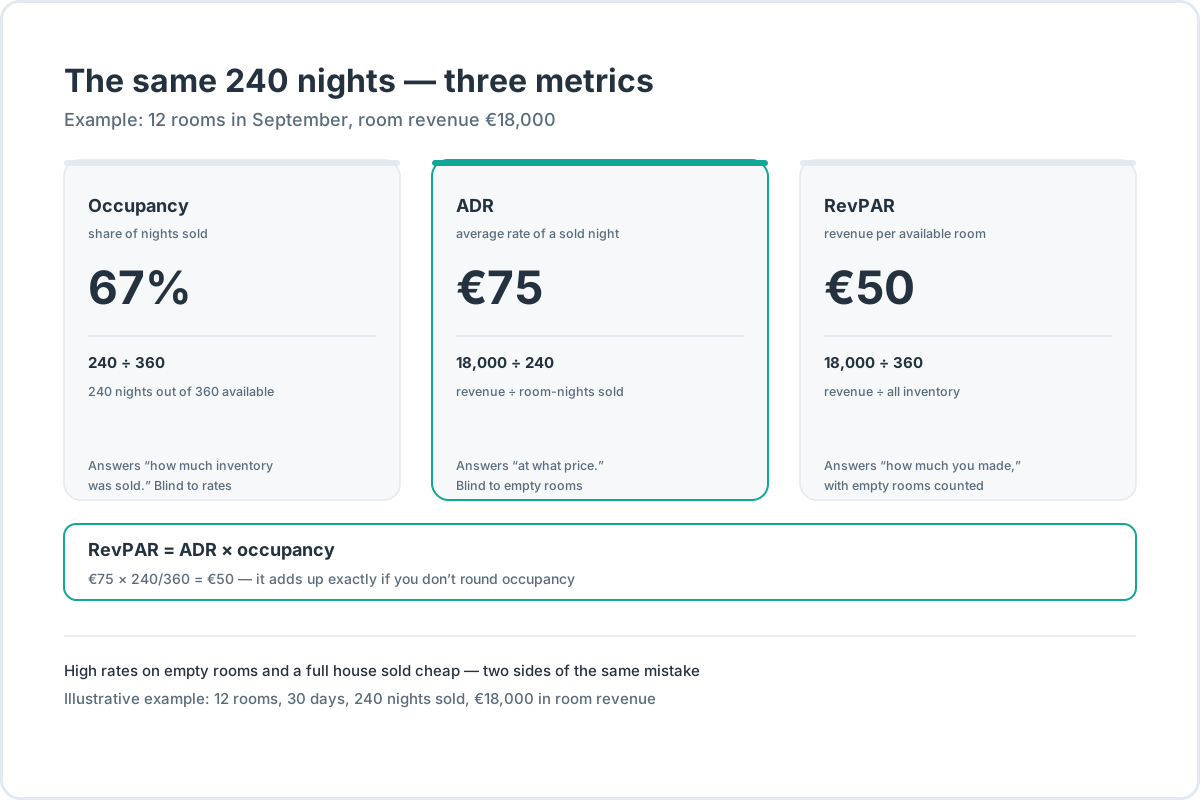
Occupancy is the share of sold room-nights among available ones: 240 out of 360 is 67%. It answers “how much of the inventory sold.” ADR answers “at what price.” Neither, alone, answers “how much did we make.”
For that there is a third metric — RevPAR. “Per available room” means the whole inventory, unsold rooms included. In our example: €18,000 ÷ 360 = €50. Every room in the property, occupied or not, brought in €50 that month.
The three metrics are tied together rigidly:
RevPAR = ADR × occupancy. It reconciles exactly as long as you don’t round occupancy: 75 × 240/360 = €50. On the rounded 67% you get €50.25 — the gap isn’t in the data, it’s in the rounding.
| Metric | What it measures | Denominator | Question it answers | What it can’t see |
|---|---|---|---|---|
| Occupancy | share of nights sold | all available room-nights | how much inventory sold | price |
| ADR | average rate | sold room-nights | at what price it sold | how many rooms stood empty |
| RevPAR | revenue per room in the inventory | all available room-nights | what you earned, empty rooms included | who paid, and with which money |
From here, two poles you meet constantly.
The first: ADR of €120 at 40% occupancy. On paper, a beautiful rate. Less than half the inventory sold — RevPAR €48, below the neighbor with ADR €70 at 85% (RevPAR €59.50). A high rate guests don’t follow is not positioning; it is empty rooms.
The second: a full house at €45. Occupancy 100% — an owner’s pride and an argument in disputes. But sustained 100% occupancy says something else too: demand is systematically above supply at your price. Someone was ready to pay more, and that difference stayed on the table. A full house also has an operational tail: no buffer for repairs, a sudden double booking, or a guest who needs another room for a night.
ADR and occupancy are not rivals; they are a pair. Reading them separately means reading half the diagnosis.
What counts as a good ADR: the honest answer
No “normal ADR” exists — not because nobody has found it, but because there is none to find: the average rate depends on the city, category, season, room mix and what nearby competitors are selling.
What to do instead of hunting for a norm:
Your own dynamics. Compare this September with last September, not with August. Break it down by day of the week: for most properties weekdays and weekends are two different economies. Year over year, season over season — the only comparison where you control both sides.
Local context. The rate can fall for reasons that aren’t yours. According to the MKG Consulting panel, Barcelona’s rate entered a squeeze at the end of 2025: December ADR was 2.6% below the previous year. In the STR and Tourism Economics forecast for 2026, rates in Stuttgart and Budapest are under pressure — new rooms are opening there. If the market in your location is heading down, your −2% may be the best result of the quarter.
Market numbers as context, not as a target. According to the Hotel Barometer (STR and Cushman & Wakefield, 1,425 hotels), ADR in Spain grew from €158.5 to €166.1 over 2025. In Southern Europe, according to STR data, it is the highest regional rate — around €175 in 2024. At the Paris Olympics in 2024 the rate reached €781 at 80%+ occupancy. Pretty numbers. They mean nothing to a 12-room property in the suburbs — except one thing: in each, price is a regional story, not a world constant.
A caveat about the panels themselves: MKG and STR count chain and branded hotels — thousands of properties, hundreds of thousands of rooms. Small independents barely enter the sample. So an “average ADR for small hotels” does not exist in public sources; you find the chain average, a benchmark of doubtful value. The real benchmark for a 9–30-room property is your own dynamics and parity across channels: the same night, on the same day, at the same rate.
Data from the MKG Consulting, STR and Cushman & Wakefield panels is current as of 29 September 2026.
Why the rate is the main lever of 2026
Demand in Europe is growing, but more slowly every year: 3.1 billion nights in the EU in 2025, up 2.2% on the previous year (Eurostat). For comparison: growth was 6.1% in 2023 and 2.7% in 2024. Volume is running out of breath.
What that means in metrics. According to the MKG Consulting panel, Europe closed 2025 with RevPAR up 1.7% and occupancy up 0.9 percentage points — volume carried the growth, not the rate. The STR and Tourism Economics forecast (Q2 2026 update) for the next two years: occupancy +0.5% in 2026 and +0.3% in 2027. The ceiling is close.
Spain shows the live arithmetic. Over 2025, occupancy there added 0.5 points (75.0% → 75.5%) while ADR added 4.8% (€158.5 → €166.1). RevPAR grew 5.5% — to €125.4. Nearly all of the growth came from the rate, not from occupancy.
The practical conclusion for a 9–30-room property: if occupancy is already good, the next step in revenue lies in the rate. If occupancy is low — occupancy first, rate second: raising prices in an empty hotel is pointless.
Data from Eurostat, MKG Consulting and the STR + Tourism Economics forecast is current as of 29 September 2026.
How to raise ADR: five levers
“Raise the rate” is not a lever; it is a hope. A higher price means fewer bookings, and the sum can go down. Below are five levers that move the rate without breaking occupancy. The rhythm for pulling them on a schedule is its own topic — covered in the revenue management guide.
1. Reputation and reviews: the cheapest lever
The link between rating and rate is measured, not intuitive. The Cornell estimate (2012, Chris K. Anderson): a one-point rise on the Global Review Index scale (0–100) let hotels raise ADR by 0.89% at the same occupancy — or raise occupancy by 0.54%, or RevPAR by 1.42%. The study is over a decade old, but a 2019 meta-regression (163 effects from 22 studies, Hu, Yang and Park) gives the same order of magnitude: the median elasticity of rate to rating is 0.851 — a 1% higher rating is associated with roughly a 0.85% higher rate.
The detail matters more: guests do not pay for service in general. In the meta-regression, the sub-ratings most strongly linked to the rate are “price/value” and “room,” while “staff” and “cleanliness” are statistically insignificant. A guest pays more for a concrete room and for the feeling that the price is fair. Hence the order of work: fix what repeats in negative reviews about the room and the price, and answer reviews — guests read them before they see your rate.
2. Segmentation: different guests, different rates
A business guest staying two weeknights, a family staying five nights in August and a weekend couple are three different demands, with different price sensitivity and willingness to pay. One rate for everyone means someone is overpaying — and someone is underpaying you.
You can start simple: look at who actually arrives (source, length of stay, day of arrival, room type) and design a rate or a package for each segment — with breakfast, with late check-out, with a minimum stay at peak. Returning guests are a value of their own: they already chose you, are usually less price-sensitive, and need a reason to come back — not a discount.
Where the raw data comes from: all bookings live in one Planner, channel bookings carry the channel’s logo. For long periods the bookings list exports to CSV — from there, average rate by segment is ordinary spreadsheet work.
3. Channel commissions: track net ADR
A night at €150 sold through a channel with a commission of 20% brings in €120. The difference between ordinary ADR and net ADR is the deduction of direct guest-acquisition costs: channel commissions, transaction fees.
| Sales channel | Rate | Commission | Net ADR |
|---|---|---|---|
| Direct (hotel’s site) | €150 | 0% | €150 |
| Channel (OTA) | €150 | 20% | €120 |
| Total: difference per night | €30 × 240 nights = €7,200 a month |
The metric is unpopular because it is unflattering — and for exactly that reason it is counted by people who manage money rather than dashboards. The industry treats it as central: an industry report on direct bookings calls net ADR the most important KPI, and Kalibri Labs has the paired metric Net RevPAR — room revenue minus acquisition costs.
The practical conclusion is two lines. First, comparing channels by headline ADR is meaningless — only by net. Second, the direct channel is the only way to raise net ADR without touching the public rate: a booking from your own site pays no channel commission. According to an industry report (over 135 million bookings, 20 markets), the average booking value from a hotel’s site is $516, from a channel $312.
An honest caveat: the direct channel is not free — site, payment processing and traffic cost money, and that too comes out of net ADR. The economics get counted from your own numbers, not the slogan “channels are evil.” Here is how the direct sales channel is built: the Booking Engine page.
4. Extras and paid upgrades: don’t confuse which one moves ADR
Of these two techniques, only one lands in ADR.
A paid room-type upgrade — yes: the guest pays extra for a bigger room, the payment lands in room revenue, ADR rises, the public rate untouched. An upgrade redistributes demand that already exists: the same inventory starts earning more.
Extras — no. Breakfast, a transfer, the spa, a paid late check-out grow revenue but never enter ADR: not accommodation lines. That doesn’t make them useless — they post to a different account. In full-service hotels, according to HotStats data for 2024, about a third of revenue comes from everything that is not rooms; a 9–30-room property has its own share, rarely zero — measure it separately, not through ADR.
Extras are sold where the guest has already decided to come: in the Booking Engine, services are set up with time slots — a transfer for a specific flight, breakfast for the right hours, a late check-out — and can be sold separately from the stay.
The boundary is simple: a surcharge for the room — ADR; a surcharge for anything that is not the room — revenue.
5. Cancellation policies and sales restrictions
Rates differ in conditions, not only price. A flexible rate — one with the option to cancel — usually costs more than a non-refundable; according to industry references, the gap is 5–15%, around 10% on average. The logic: the freedom to cancel is paid for. The non-refundable rate collects the savers — and that is fine: the two have different jobs.
A common belief here is inverted. “The non-refundable sells better” misses the point: it is cheaper — yes — hence it gets picked more often. The flexible rate’s role in ADR is different: it raises the average rate on the back of the guests who need the freedom, and the market monetizes this literally — Booking.com already sells flexible cancellation as a paid add-on to a non-refundable rate.
The second instrument is sales restrictions. A minimum stay at peak (don’t sell Friday as a single night if an empty Saturday follows it), a maximum stay where one guest holds a room for two weeks in the most expensive period, closed arrivals or closed departures on specific dates. This is a way to change the mix of nights you sell — and with it the average rate — without moving the price list. In rate plans, restrictions live next to prices and cancellation rules and are pushed out to the channels together with them — otherwise half the plan stays on paper. For how to assemble such a set, see the article on setting room prices.
ADR on its own means nothing
The most important part of this article is about what ADR does not do.
ADR went up — the hotel earned more? Not a given. Raise the rate 15%, lose a third of your bookings: RevPAR falls, and the “price/value” ratings slide after it — the future rate slides too. Watching ADR alone, you would have noticed nothing but “great dynamics.”
ADR went down — trouble? Also not a given: the guest mix changed, a lower-rate channel was added, and occupancy climbed ten points.
So a pair, never a solo: ADR with occupancy — better yet the three with RevPAR, better still all three net of commissions. And always movement across periods, not a single absolute value.
The practical minimum for a busy owner: once a month, count three numbers by the formula in this article — room revenue, room-nights sold, room-nights available. Ten minutes in a spreadsheet. ADR asks no more of you: it is a diagnosis, not a goal.
Where the numbers come from — and where they won’t
Start with what will not be here: ready-made management analytics at chain level — ADR, RevPAR, demand forecasting — do not exist in a PMS for a small hotel. These metrics are computed not by the system but by you, on top of its data: a spreadsheet and the formula from this article. What you need from the system is different — for the raw numbers to sit in one place, not to be gathered from four windows.
What HotelsCalendar has of this:
- Day dashboard — today’s check-ins and check-outs, who is in the house, rooms free, bookings with a balance due. Absolute numbers, the ones your occupancy is made of: 12 rooms, 9 occupied — there’s your count.
- Planner — bookings from every source in one calendar; channel bookings carry the channel’s logo on the bar. This is where the mix of sold nights by day and room type comes from.
- Rate plans — prices, cancellation policies and sales restrictions in one place. Changing a price for a date is one click; a bulk update shows a “before → after” preview before applying.
- Bookings CSV export — for a period, by arrival dates, with a channel filter: from there, a spreadsheet and the formula.
In other words: the system collects the facts, and the rate and the conclusions stay yours. For how this fits together with the rest of a small hotel’s software, see the article on software for a small hotel.
Frequently asked questions
How is ADR different from RevPAR and occupancy?
By the denominator. Occupancy divides sold room-nights by all available ones; ADR divides room revenue by sold room-nights; RevPAR divides the same revenue by the whole inventory — empty rooms included. The link is rigid: RevPAR = ADR × occupancy. That is why ADR alone is half a diagnosis: €120 at 40% occupancy earns less money than €70 at 85%. For how the whole set of systems behind these numbers fits together, see the article on software for a small hotel.
Do breakfast and extra services count toward ADR?
No. The numerator of ADR is room revenue only. Breakfast, transfers, the spa and other services are other revenue lines; they don’t affect the average rate. The exception is a package where the meal is baked into the rate’s price: then breakfast counts as part of the rate — but the approach must be fixed and kept month after month. Extra services remain a working way to grow revenue per guest — they just need their own number, not ADR. They are sold where the guest has already picked their dates — in the Booking Engine.
How do I calculate ADR if the system has no ready report?
By hand, by the formula: room revenue for the period ÷ occupied room-nights. Take the revenue from the till or your payment records — with a caveat: the money journal in the PMS shows the current month, so for past periods the numbers come from CSV or the payment provider. Occupied nights come from the Planner: with the CSV export, the count takes a minute. Once a month is enough — the PMS collects the raw numbers, the arithmetic stays yours.
What is a good ADR for a small hotel?
There is no universal value: the rate depends on city, category and season. The working reference is your own dynamics: this month against the same month last year, weekdays separately from weekends. Market numbers help only as context: for example, the average ADR in Spain over 2025 was €166 — but that is chains, not a 12-room property. The second reference is parity across channels: the same night shouldn’t sell cheaper in one channel than another. Rates are edited in one place, and the Channel Manager delivers them to every channel.
What is net ADR, and why does it matter?
Net ADR is the rate minus the direct costs of acquiring the guest: channel commissions, transaction fees. A night at €150 with a 20% channel commission brings €120. Without this correction, channels all look the same while earning different money — which is why net ADR is the one to compare. Commissions — where they come from and what the guest pays the intermediary for — are covered in the article on OTAs.
How is ADR different from the price on the hotel’s website?
The website price is the public rate: what the guest sees before discounts and promotions. ADR is the actual average across sold nights — discounts, promo codes, channel rates and upgrades included. The two coincide in one case only: not a single sale in the period deviated from the price list — which almost never happens. Managing ADR through the public price is the job of the Booking Engine: it is where you decide which rates and conditions the guest sees at all.
Which nights are excluded from ADR?
All unsold ones: house-use nights for staff, complimentary stays and rooms out for repairs bring no revenue and don’t dilute the denominator. Counting them is easy when bookings and room closures live in one calendar: in the PMS, a repair shows up right in the Planner.
Can you raise ADR without raising the public rate?
Yes: paid room-type upgrades (the surcharge lands in room revenue), rate segmentation by guest type, and flexible rates — per industry references, flexible cancellation costs 5–15% more than non-refundable. The public price doesn’t move.
ADR went up but revenue didn’t — why?
Most likely, occupancy fell: RevPAR = ADR × occupancy, and a 10% higher rate with a quarter of the nights lost is minus in money. That is why ADR is never read without occupancy — both metrics draw on the same sold nights.