


Notes for hoteliers
OTAs: what they are, how they work, and how to choose your channels
cottonbro studio / Pexels
A guest at the front desk says, “I booked on Booking.com.” The owner of a fourteen-room hotel nods, opens the Planner, and types it in. A month later the channel statement arrives: the commission, for that booking and forty more like it. That’s when the question comes up—the one to ask before connecting a channel, not after: what is an OTA, what do they cost, and how many do you need?
Start with the name. An OTA (online travel agency) is a website that pulls many properties into one catalog, shows a traveler prices for their dates, and charges a commission for bringing the guest. Booking.com, Airbnb, Expedia, Agoda—all OTAs.
For a small property, this is not “one more source of demand.” Per an industry report (90+ million bookings at independent properties in 2025), channels took 63.4% of bookings—61% a year earlier. Booking.com remains the world’s most-visited travel site, averaging over 420 million visits a month (Similarweb). In the EU, travelers spent 952 million nights in 2025 through three platforms alone—Airbnb, Booking.com, Expedia—up 11.4% on the year before (Eurostat; EU only, and only those three).
That scale is no reason to pay in silence. It’s a reason to understand the mechanics: what a property pays for, where the commission ends, and when a second channel stops being free—in stress, if not in cash. Let’s take it in order.
OTAs in plain words: a channel that sells for you
The guest doesn’t come to your hotel—they come to a catalog. City, dates, dozens of properties in one list: photos, reviews, prices, cancellation policies—and a booking made without leaving the site. For them, a way to compare and not get it wrong. For you, a storefront you didn’t have to buy, build, or promote.
Why there, not an ordinary web search? In one place the guest gets price comparison, reviews from other travelers, payment by card, and support if something goes wrong. Compared, booked, confirmation in the inbox. The short path wins.
Hence the main thing: an OTA is not advertising, it’s a point of sale. The booking happens inside the channel; the money, the cancellation rules, and the review all live on its side. You control the listing, the price, availability—but not the purchase. That is why the channel wants a percentage.
How OTAs work: who pays whom, and when
Behind the word “commission” hide three settlement models. Which one a channel uses decides who gets the money, and when.
The agency model. The channel brings the guest and takes a commission—by distribution-industry estimates, usually 15–25% of the booking total. The guest pays the property; the money stays with you minus the percentage. That is how most channels a small hotel deals with work.
The merchant model. The channel buys the room at a net rate and resells it with a markup; the guest pays the channel, you receive your net amount. Two consequences: the money arrives late, and the price in the listing isn’t built from your price alone.
The wholesaler (bedbank). A middleman contracts room volume at net rates and distributes it onward through tour operators and online retailers. The B2B layer—nearly useless to a small property; worth knowing only so bookings arriving through a chain of middlemen don’t surprise you.
One channel can run several settlement modes, so ask before connecting: who charges the guest’s card—you or the channel? Booking.com runs both: in one, the guest’s card details come through and the hotel charges; in the other, the channel collects the payment and sends a virtual card to charge.
What a channel costs: how the commission adds up
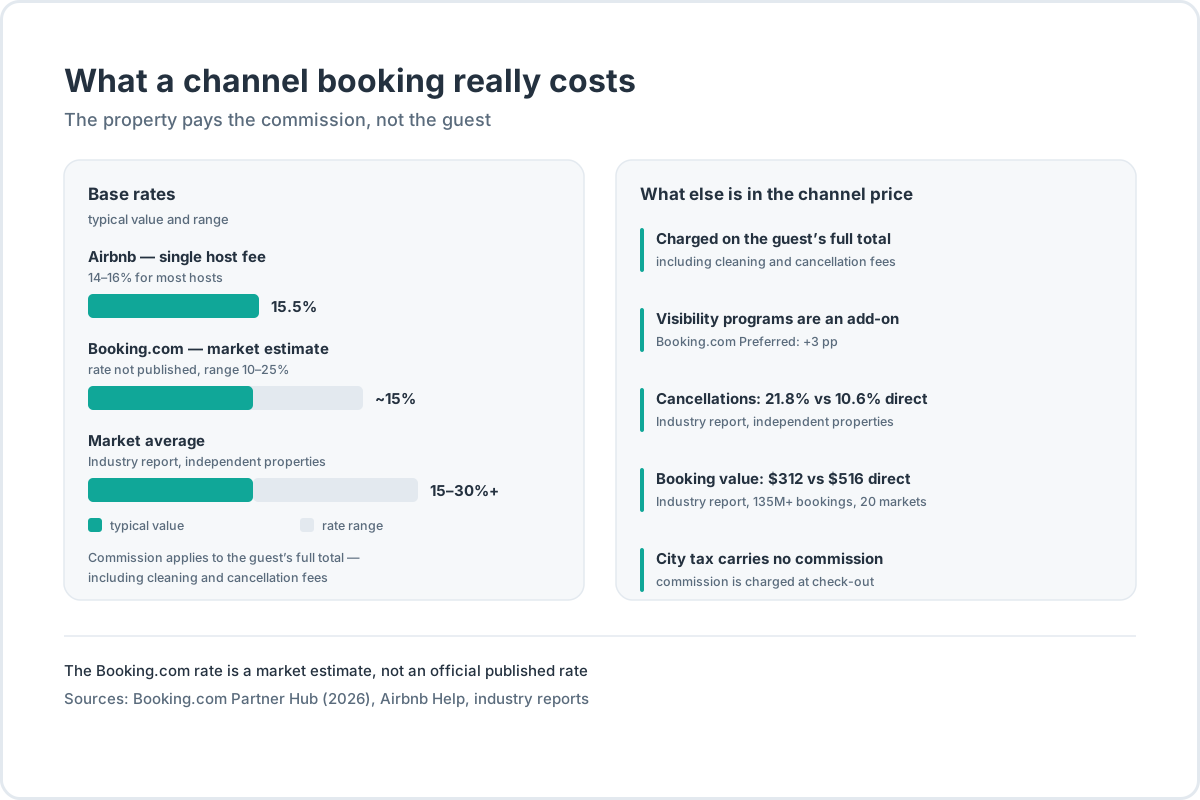
The reference points on rates:
Airbnb charges a single host fee of 15.5% (most hosts sit between 14% and 16%). No guest service fee in this model: the property pays the whole fee. For hotels, aparthotels, and anyone on a PMS or Channel Manager, the model is mandatory—“splitting” the fee with the guest is not an option.
Booking.com doesn’t publish its commission. The market estimate is about 15%, typically ranging 10–25%. An estimate, not an official rate: the exact percentage depends on the country, the property type, and your agreement.
Across the market, the average commission runs 15–30%+; a decade ago the average was around 10% (industry report). Niche and regional channels start at 4%—and deliver a much thinner flow of bookings.
Three clarifications, without which these numbers deceive.
First: the commission is calculated not on the room price but on the full amount the guest paid—including cleaning and cancellation fees. City tax is exempt.
Second: the real rate is higher than the base one. Visibility programs and paid promotion are add-ons: the Preferred program at Booking.com adds roughly three percentage points, and Genius discounts are funded by the property itself.
Third: commission is not the whole cost. Industry data: 21.8% of channel bookings get canceled, against 10.6% of direct ones. Industry report (135+ million bookings, 20 markets): the average booking from a hotel’s own site is worth $516; from a channel—$312. A channel brings more bookings; run the numbers in money, not bookings. How to work out your rate after commission—in the ADR article.
An outside brake exists, too: in May 2025 the Swiss regulator found Booking.com’s commissions excessive and ordered a cut of roughly 25%; the company is appealing. A rare administrative “haircut”—and telling: pressure on channel rates has started, not just been discussed.
Now a simple calculation for a 12-room property. Say a channel brings twenty bookings a month at an average of $312 (industry report), commission 15%: 20 × $312 × 15% = $936 a month—only the base rate, no visibility programs. Then cancellations: 21.8% of channel bookings, roughly four of the twenty, and those dates go back on sale at the last moment. Nothing sinister about that. But a channel should be judged in money per month, not in a percentage on paper.
Metasearch: close by, but not a sales channel
Metasearch is a results aggregator: it collects prices from several sources, including your own website, and shows a list of links. No booking happens inside—the guest clicks through to wherever they will pay. Trivago, Kayak, Google Hotels—metasearch.
It gets paid differently. Basic links to your own site on Google are free; only promotion costs money. Paid models are mostly cost per click; some platforms add commission-based options—the property picks the rate it pays on metasearch bookings, usually 12% to 25%.
The boundary is blurring, though. In August 2026, Google switched on hotel booking right inside AI Mode—US only for now. When search turns into purchase, metasearch stops being a list of links and becomes a competitor to the channels.
The major channels: who’s who
Every channel has its own audience and its own geography. The good news for a 9–30 room property: the list you actually need is almost always shorter than it seems—one or two channels plus your own site.
Booking.com—the base channel. At the end of 2025 the platform had about 4.4 million properties, and nearly 9 in 10 are homes: houses, apartments, aparthotels. Classic hotels, motels, and resorts number about 500,000 (Booking Holdings, 2025 annual report). The takeaway: you compete not with chains but with properties like yours. About 36% of its room nights are alternative accommodations; over half are booked in the app. One subtlety: “direct” in Booking.com’s reports means direct to the platform, not to you.
Airbnb—a marketplace for homes. Founded in 2008; the host decides on instant bookings and sets the house rules. The fee is 15.5%, charged to the property. Protection comes from AirCover: damage coverage up to $3 million and liability up to $1 million—a program with conditions and exclusions, not unconditional insurance. Read it before an incident, not after. The channel also grows faster than the market: in the fourth quarter of 2025, nights booked on Airbnb grew 10%.
Expedia Group—a portfolio of brands through one connection. Expedia, Hotels.com, Vrbo, Travelocity, Orbitz, and the group’s other brands are tied together by the One Key loyalty program. The practical upshot: one connection, several storefronts. In Europe it is the third channel by weight, not a “second Booking.com”: growth is pulled mainly by the group’s B2B arm, not by hotel bookings from small properties.
Agoda—Asia. Founded in 2005 in Thailand, owned by Booking Holdings since 2007—the same group as Booking.com, not an independent channel, worth knowing so your map of the channels stays honest. The separate Agoda Homes branch works only with whole properties: apartments, villas, houses.
HRS—business travel. A channel out of Cologne, operating since 1972 and strong in the corporate segment: tenders, company programs, billing to corporations. For an independent 9–30 room property—niche.
Tripadvisor, which until recently sold lodging in Europe, left that business at the end of 2024—today it is closer to reviews and content than to a booking channel.
How to read this map. Channels aren’t competitors standing in one line; they’re different storefronts with different guests. You don’t need the maximum—you need the ones matching your geography and format. An extra channel costs not money—a listing is free almost everywhere—but attention, and attention runs out first.
| Channel | Strength | Best fit |
|---|---|---|
| Booking.com | the biggest reach and ready demand | the base channel for nearly any small property |
| Airbnb | an audience for apartments and unusual stays | apartments, guesthouses, properties with character |
| Expedia Group | several brands through one connection | a second or third channel; more often outside Europe |
| Agoda | demand from Asia | properties with guests from Asia |
| HRS | corporate travel | properties with a corporate guest flow |
What channels give you—and what they cost
A channel’s strength is not advertising but a ready-made sales infrastructure: listing, reviews, payment, support, guest protection. Entry is free—you pay per booking. For a new property it’s the shortest path to the first guests, especially with no website yet.
The flip side is four things worth counting in advance.
- A commission on every booking—on the guest’s full amount, not the room price.
- The guest is never quite yours. Newsletters, repeat bookings, the loyalty program—the channel’s, not yours.
- The rules change without asking. Visibility programs, display order, discount mechanics—the channel decides, the property adapts.
- Cancellations run higher, booking values lower. 21.8% vs 10.6%, and $312 vs $516—in channel economics these two numbers mean more than the base commission.
And a separate item: dependency. If all demand flows from one channel, you are not so much selling through it as working on its terms. Not an argument to leave the channels—an argument to know what share of your bookings is genuinely “yours.”
A word on the “billboard effect”—a guest finds a property on a channel and books direct. It was documented historically (Cornell University studies, 2009 and 2011), but later industry work no longer reproduces it: search behavior has changed. The safer logic: the guest saw the property on a channel, remembered the name, found the website later. That happens. But you can’t build a budget on it.
The direct channel: not instead, but alongside
A direct booking earns more—the value shows it: $516 vs $312 (industry report). But the direct share doesn’t grow by itself: in the 2026 industry report (135+ million bookings, 20 markets), it moved by no more than 1.5 percentage points in 95% of markets, and direct bookings make the top three channels in 90% of them. The direct channel holds steady for those who invest: a website, a Booking Engine, metasearch, payments.
For the first time, the law is on the property’s side. Since November 2024, Booking.com has been bound by its Digital Markets Act obligations: it may not raise your commission or delist you for pricing lower on your own site. The platform itself confirms: price and availability on your site affect neither your ranking in the European Economic Area nor access to the paid promotion program.
And what stays with the direct guest is the data: contact, stay history, repeat bookings. A channel almost never gives you those. A Booking Engine is exactly what turns your website into that kind of channel.
What’s changing: the storefront is shrinking
Booking.com and Expedia became pilot partners of OpenAI: since October 2025, lodging can be searched and booked right inside ChatGPT—not available at launch in the European Economic Area, Switzerland, or the UK. Google has switched on hotel booking in AI Mode, in the US so far.
The more telling signal: the channels themselves call AI a risk. Booking Holdings’ annual report says it plainly—AI assistants may shrink the share of travelers who come to dedicated platforms, and with it direct traffic, bookings, and customer relationships.
The conclusion cuts both ways. Presence in the channels’ inventory is presence in the new AI storefronts—so far built on the platforms’ catalogs, not hotel websites. And the guest sits one step further from the property, which only makes data about them more valuable.
How to choose channels: six criteria
-
Where your guests live. Look at the geography of your current arrivals and your property’s format. For apartments and guesthouses, Airbnb usually pays off more than for “classic” hotels; demand from Asia is Agoda; business travelers are HRS. For Europe, Booking.com remains the base—the question is what to add to it.
-
The real commission, not the base one. What sits inside the rate: cleaning and cancellation fees, visibility programs, who pays the guest fee. Count it from the channel’s statements for recent months, not from the number in a sales deck.
-
Who pays, and when. The settlement model defines your cash flow: you charge the guest’s card yourself—or the channel collects the payment and transfers the money, sometimes via a virtual card you must charge. The second way: delayed money and an extra step in the books.
-
What the channel demands of the listing. Photos, description, amenities, check-in and check-out times, cancellation policy—every channel has its minimum. From May 20, 2026, an EU regulation on short-term rental data is in force: platforms must check and pass booking data to the authorities, and properties increasingly need a registration number—without one, the listing may not go through.
-
What rules are imposed on you. Cancellation and no-show terms, penalties, price restrictions in other channels—read before signing, not at the first conflicting booking. After the Digital Markets Act, Booking.com can no longer enforce rate-parity clauses in the EU: pricing lower on your own site is legal.
-
How the channel plugs into your system. If availability and rates have to be moved by hand, the channel costs more than its commission—in time and double bookings. Check whether the channel is in your channel manager’s catalog, and what goes into the sync: prices, restrictions, closed dates.
While you have one channel: the manual routine
One channel is one browser tab, and manual entry keeps up: you key bookings in yourself and close availability on dates when a room is taken or under maintenance. The price of that mode is not money but your receptionist’s attention: reconciling with the channel becomes a daily ritual, and rituals don’t forgive skipped days.
What’s worth keeping in order:
- The listing. Photos, description, amenities—what the guest compares you on. A weak listing loses impressions even at a good price.
- Rates and restrictions. Minimum stay, closed arrival and departure dates, cancellation terms—set up in rates, not by editing the price on a date. More on rates—in the article on pricing your rooms.
- Availability. Accurate for every day. Selling an occupied room is a property’s most expensive mistake.
- Reviews. How fast and how well you reply feeds the guest score, and review freshness matters too—Booking.com’s documentation confirms it. Ranking mechanics are a topic of their own (the article on OTA ranking algorithms); the rule here: reply to everyone, fast.
With the second channel, the arithmetic begins
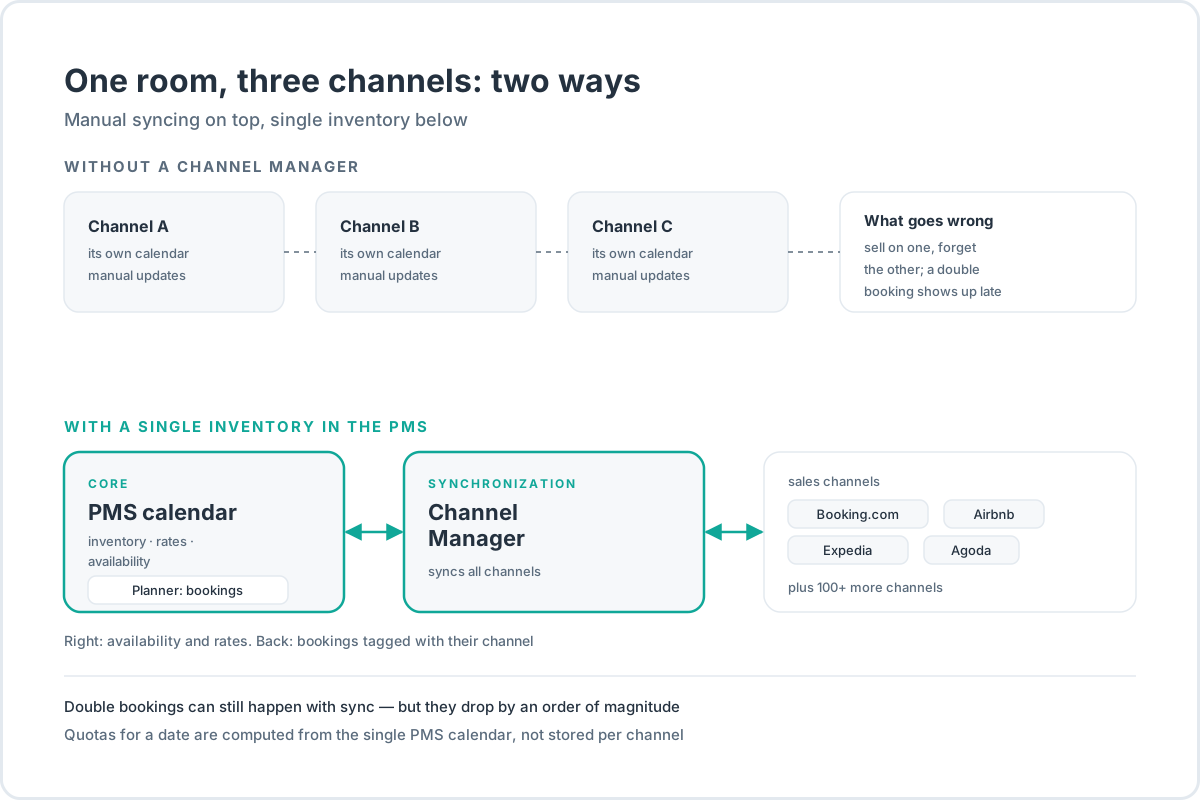
While there is one channel, it all fits in your head. The second brings a problem with no tidy manual solution: the same room is on sale in two places. Sold in the first—there’s a spare one left in the second. Closed in the second—forgotten in the first. A double booking is not a small nuisance; it’s a guest without a room: being walked to another property, compensation, and a review you can’t delete.
This is exactly the problem a Channel Manager solves. It keeps availability and rates identical across every channel, and computes the quota for a date from the single PMS calendar—no separate counter per channel. A room sells—the count drops everywhere else. You close a date—the quotas zero out across the board. A booking from a channel lands back in the calendar on its own, tagged with its source. The Planner still holds bookings; prices live in rates.
Connecting a channel means a searchable catalog (mature systems list over a hundred: Booking.com, Airbnb, Expedia, and dozens of others) and mapping room types and rates—after that, availability and restrictions upload themselves, two years ahead. Every connection shows its status: active, paused, error. The delivery log shows what went to which channel, and when. And if something goes wrong, one action forces a sync.
An honest caveat: double bookings don’t disappear entirely. Channels race one another for the same room, and in rare races a booking slips through—it goes into processing. The difference is not “zero conflicts”; it’s that a conflict becomes a one-off incident instead of a daily lottery.
To see how it’s built—the Channel Manager page.
The bottom line: a minimum channel setup
- One channel plus your own website—a working minimum for most 9–30 room properties. The channel brings demand; the website brings margin and guest data.
- A second channel—when there’s a reason: an audience you’re not reaching, empty rooms in the low season, a new market.
- The real commission is counted on the guest’s full amount and from actual statements, not from a base rate in a deck.
- From the second channel on, manual transfer can no longer keep up—that’s the line where a Channel Manager becomes necessary.
- Direct bookings don’t replace channels; they balance them. The direct share doesn’t grow by itself—you invest in it.
If you’re still assembling a property’s whole system, start with the article on small-hotel software—on the order of adoption and what to buy first.
Frequently asked questions
What does OTA stand for?
Online Travel Agency. In practice: any website that gathers properties’ listings, brings the guest, and charges a commission—Booking.com, Airbnb, Expedia, Agoda. “OTA” and “sales channel” are often interchangeable in hospitality writing, though channel is broader: your own website is a channel too. How channels fit into a property’s stack—the article on small-hotel software.
How is an OTA different from metasearch?
An OTA takes the booking and charges a commission; metasearch only compares prices and sends the guest to the source: Trivago, Kayak, Google Hotels. For a property the difference is money: with a channel, a commission per booking; with metasearch, payment for impressions and clicks if you promote. Your own website can get into metasearch too—it needs a booking page for that, usually a Booking Engine.
How much do OTAs charge per booking, and who pays the commission?
The property pays, not the guest. Reference points: the market average is 15–30%+ (industry report); Airbnb charges a single host fee of 15.5%; Booking.com is around 15%, typically ranging 10–25%. The commission is calculated on the full amount the guest paid, including cleaning and cancellation fees.
Is Airbnb an OTA?
Formally a marketplace for homes; mechanically, yes—a sales channel with a commission. For hotels, aparthotels, and everyone on a PMS or channel manager, the single host fee of 15.5% applies: splitting it with the guest is not an option.
Why do multiple OTAs cause double bookings?
Every channel keeps its own idea of how many rooms are free, and updates it at its own pace. Until those ideas are synchronized from one place, the same room sells twice. A Channel Manager computes quotas from the single PMS calendar and updates the channels on every sale—details on the Channel Manager page.
How many channels does a property with 10–20 rooms need?
Most often, one or two channels plus your own website: that keeps sync manageable and the economics legible. Inventory, rates, and bookings then live in one system—the PMS—not across the dashboards of each channel.