



Notes for hoteliers
How to price a hotel room: rack rate, floor rate and BAR

Mikhail Nilov / Pexels
A Saturday in late July. Your site shows €95 for a double. The hotel across the street is at €80 — and hasn’t had a free room since May. You have sold six of twelve. The first thought is “drop the price.” A month later the second one arrives: “am I giving rooms away?”
Both thoughts come from the same place: the price had nothing to be assembled from. No floor below which selling is forbidden. No ceiling to hold your self-respect. No base for counting discounts. Just the neighbor’s number and a feeling that “ours is nicer anyway.”
Here is how to assemble it differently: three anchor values every date hangs from (floor rate, BAR, rack rate), a rate-plan set for a 9–30-room property, the four inputs a price is built from — and the channel arithmetic after which “the same price” means different money.
Rate, price and rate plan: three different things
In conversation these words merge into one. In sales management, keep them apart — otherwise your rates stop obeying you.
A rate is the amount per night assigned to a room type for a date. “Double, Saturday, €95” — that is a rate.
The price is what the guest ends up paying: after the city tax, discounts, the recalculation for the guest mix. A family with a child doesn’t pay the €95 a couple pays.
A rate plan is a rate together with its selling conditions: whether it can be canceled, whether prepayment is required, what meals are included, which restrictions apply. One room on the same night normally sells under several plans: flexible at €95 with free cancellation, non-refundable at €85. Not a conflict — that is how sales are built.
The working consequence is boring: assigning a price to a room “in general” is pointless. A price lives in the combination room type × date × rate plan — one base price per night, split into several offers by conditions and guest mixes. Without anchor values, the combination collapses into a list of prices nobody has time to maintain — which is what the rest of this article is about.
Three anchor values: floor rate, BAR and rack rate
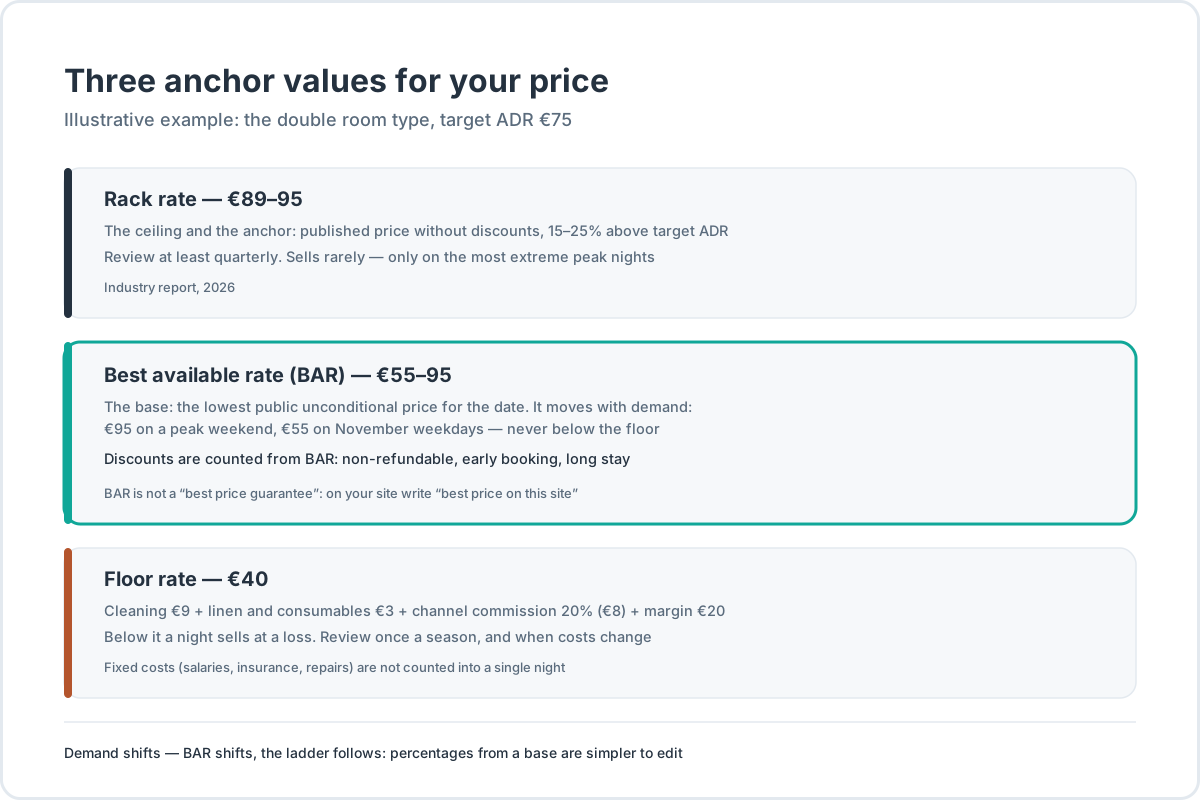
Every date has three values worth knowing before you set its price. Everything else lives between them.
The floor rate: counted from an occupied room
The floor rate — colloquially, the price floor — is the line below which a night is not sold. It is counted not from the revenue you dream of but from the cost of an occupied room: what you spend so the guest can arrive and sleep there.
An example for a 12-room property (illustrative numbers — substitute your own):
- Cleaning the room and consumables — €9.
- Washing the linen and towels — €3.
- Channel commission — 20% of the price.
- Target margin from an occupied night — at least €20.
At a price of €40 the commission eats €8, costs eat €12, and €20 stays in the till. Any lower, and the margin is gone. So €40 is your floor rate for this room type.
Salaries, insurance, property taxes and repairs are not in it: fixed costs are covered by the margin, not counted into every night. If the per-night margin systematically fails to cover them too, the problem is the economics of the property, not the price of one night — and discounts don’t fix that.
Why know the floor before the sale: so a discount is a decision, not a fall. Selling below cost out of ignorance: low season, the room empty anyway, the price cut to €35 — and a night that cost you €12 and should have brought €20 brought €16.
In the PMS, the floor can be pinned to a room type: the room type card has “Price restrictions” — a minimum and maximum price in the property’s currency. An honest caveat: the limits apply to prices the system computes automatically, through rate inheritance and formulas; a price typed in by hand passes the limit, with a warning.
Rack rate: the ceiling and the anchor
The rack rate is the published price without discounts or promos, its own for each room type. Historically the “at the desk” price, paid by whoever didn’t land in any offer.
In practice it is more a reference figure than a real selling price: rooms sell at it rarely, on the most extreme peak nights. Its job is different — a ceiling and an anchor. It shows how deep a discount is: “30% off €95” tells the guest more than “only €66.5.”
The working guide: set the rack rate 15–25% above target ADR and review it at least quarterly (Lighthouse, June 2026). For a double with a target ADR of €75 the ceiling comes out at €86–94, usually rounded to €89 or €95.
The same Lighthouse notes that in revenue teams’ day-to-day work, rack rate and BAR often converge: the ceiling stops being an abstraction and becomes the price of the most expensive dates. For a small property this is convenient — one room type, one ceiling — and how far above ADR you tune from your own history over a couple of seasons.
BAR: the best available rate
The best available rate (BAR) is the lowest public unconditional price for a specific date. No prepayment, no non-refundable clause, no booking 21 days ahead. It moves with demand: on a peak weekend BAR sits close to the ceiling; on November weekdays it is noticeably lower — but above the floor.
BAR is not “the most attractive price for maximum profit,” as it is sometimes written. It is the base discounts and special rates are counted from: non-refundable, early booking, long stay. Demand shifts — BAR shifts, and the ladder shifts after it. Edit every price one by one and the ladder falls apart; hold BAR plus percentages, and there is nothing to fall apart.
One wording caveat: BAR and a “best price guarantee” are different things. You cannot promise the guest that nowhere will be cheaper — channels manage their own markups. The correct wording on your own site is “the best price on this site,” and it works with the advantages discussed below.
Three values, three different jobs
| Value | What it answers | Where it comes from | How often to review |
|---|---|---|---|
| Floor rate | “Below this — don’t sell” | Cost of an occupied room + margin | Once a season, and when costs change |
| BAR | “The base of today’s ladder” | Demand, occupancy, booking window, competitors | Weekly, and before events |
| Rack rate | “The ceiling and the reference point of discounts” | Target ADR + 15–25% | At least quarterly |
The rate ladder: four rates instead of one
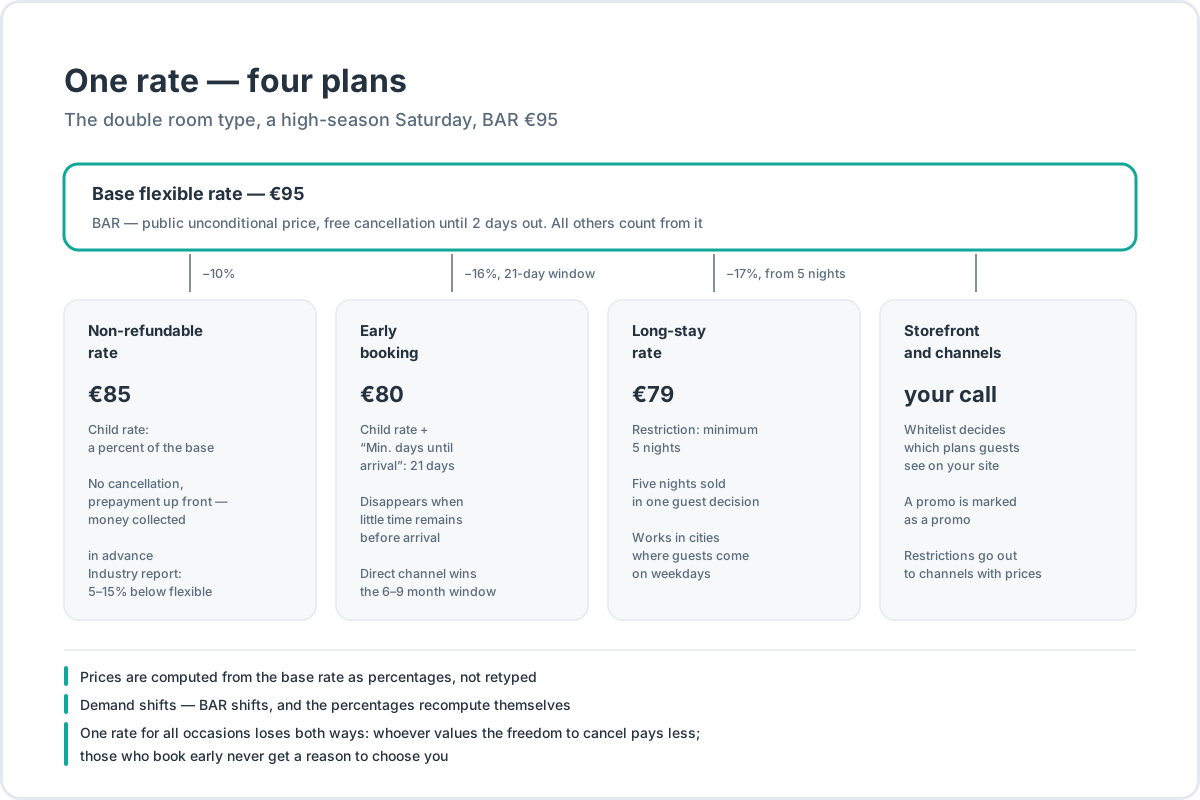
One rate for every occasion is not simplicity but money lost from both ends: those ready to pay for the freedom to cancel pay less than they could; those ready to book early and not cancel never get a reason to choose you.
The minimal set that carries a property of 9–30 rooms:
The base flexible rate. BAR with free cancellation until 2–3 days before arrival. This is your price list, the comparison point for everything else.
The non-refundable rate. Per industry references it sits 5–15% below the flexible one, around 10% on average: at a BAR of €95, that is €85. What sells it is not the discount but money collected in advance: a booking that cannot be canceled will not be canceled.
Early booking. A discount for buying early — on the market, from 10% for bookings made 21 days ahead or earlier. The point is not the percentage but the window: the rate must disappear when little time remains before arrival, otherwise you hand early prices to people who would have come at full price anyway.
The long-stay rate. From five nights — a lower price, but five nights already sold in one decision. In cities where weekday guests come for work or study, it often works better than any discount.
The mechanics of all four are the same: a child rate with a percentage change from the base, plus restrictions. Early booking is a minimum advance purchase of 21 days (“Min. days until arrival”); the long-stay rate is a minimum stay of 5 nights. Restrictions live in the same system as prices and go out to the channels with them — otherwise half the plan stays on paper.
One last touch — the storefront. Which plans the guest sees in the booking engine is your call: an extra rate comes off, a promo is marked as a promo. Early bookings land on the far window, where the direct channel wins price comparisons more often — per World Parity Monitor (H1 2025), its strongest interval is 6–9 months before arrival. How the storefront works — in the article on the Booking Engine.
What to go by: four inputs
The anchor values set the frame; four inputs suggest what fills it.
Your offer and perceived value
Guests don’t know what a room costs you — they know what the trip costs them. They judge the price through what they get: the view, breakfast, a quiet courtyard, parking, the distance to the sea or the center, the way you talk to them before arrival.
So a price is not just the arithmetic of costs: a room with a story in the reviews — about breakfast and the view — holds a higher price than the neighboring one with the same square meters. Carry the strength into the rate instead of hiding it in the description — a breakfast package, a parking package, late check-out as a paid extra. What the guest perceives as value monetizes better than a blanket discount.
And the reverse: what you don’t have — an elevator, a spa, your own restaurant — is not a reason to undercut. It is a reason to check whether you are comparing yourself with a property of a different class.
The calendar: season and events
Seasonality is the one factor that is almost entirely predictable. But two things have been spoiling the familiar grids in recent years.
The first is events. They are monetized by the rate, not by occupancy. A counterfactual HVS analysis of the 2026 World Cup across 11 US markets counted $680 million in additional room revenue: the rate rose in all 11 markets, occupancy fell in seven. For a 12-room property, this means: raise the dates of a concert or a city festival in advance and by hand, in the price calendar — don’t wait for them to “pick up on their own.”
The second is that the season is blurring. In Barcelona, Istanbul, London, Paris and Rome, July–August 2025 came out noticeably weaker than May–June and September–October — in hotels and short-term rentals alike. 28% of travelers from the eight largest markets intend to shift trips to other months within two years, mostly to avoid crowds (European Travel Commission, Q3 2025); 31% plan shoulder-season trips (Skyscanner). The practical conclusion: build the price grid on actual demand, not calendar habit — and don’t call May “low season” just because it was one five years ago.
Competitors: a check, not a price war
For 9–30 rooms, competitor monitoring is manual work, and that is normal. Pick 3–4 comparable properties: same location, same level, same set of services. Compare identical dates, the same room type, the same guest mix, the same booking window — otherwise the comparison means nothing. In season — more often; off-season — less.
The goal is not to copy and not to undercut, but to understand what is being sold for that money: the neighbor’s rate may have breakfast and parking baked in while yours doesn’t — then his “€80” is not your €80. Sometimes the check brings an idea you didn’t have: a three-night Friday-to-Sunday rate, a separate price for early check-in, a late check-out package.
Automated rate monitoring is a separate class of tools; a small property usually doesn’t have one, and buying it first is unnecessary. A spreadsheet of four properties, refreshed weekly, covers most of the question.
Booking history and the booking window
The third input is your own data: when people book, how many days ahead, for how many nights, from which channel.
The main change here: the booking window has compressed. Per Lighthouse search data (three years of observations, 2023–2025), the share of accommodation searches within 28 days of arrival grew from 9% to 38%; one-night trips grew from 28% to 37% of queries. In the US, bookings within two weeks of arrival rose from 29% to 34% in a year.
An industry traveler survey from 2026 (about 12,000 respondents across 14 countries) disagrees: travelers there say they plan earlier. Not a contradiction — two different measurements: search data shows what people do, the survey what they think of themselves. The first matters more in practice, but either way the conclusion holds: pricing decisions are made earlier and reviewed more often than “once a season.”
Hence a simple calendar rule: seasonal and event prices are set in advance and reviewed weekly. A compressed window leaves less time to react to emptiness: a month before arrival is no longer “early,” it is “on time.” To see emptiness coming, watch booking pace on future dates — how that works is in the article on OTB.
Move the price with demand — without a revenue department
Dynamic pricing is market practice, not a chain-hotel luxury: the price moves with demand, occupancy and the booking window. Usually a revenue management system (RMS) stands behind it, recomputing prices on its own. A small property doesn’t have one — and doesn’t need one: at a dozen rooms, the same logic is assembled by hand from a corridor and a calendar.
The corridor you already have: the floor rate and the ceiling. What remains are the steps inside:
- the price climbs with occupancy: the first five rooms of a room type at BAR, the next ones higher, the last ones at the ceiling;
- weekdays differ: for most properties, weekdays and weekends are two different economies — market estimates put the gap at up to 15–20% (a secondhand figure: verify it on your own history, don’t take it as a norm);
- a minimum stay is added in peak windows, so a short night doesn’t eat the expensive one next to it;
- events are priced in advance and by hand, as in the World Cup example above.
Travelers accept this logic: 65% agree a hotel should raise prices in peak periods, and 83% are ready to shift dates for a benefit (industry survey, ~12,000 respondents across 14 countries). A high Saturday rate is not an insult to the guest but a legible signal; most of those unwilling to pay simply move the trip to Friday.
All the mechanics are editing a date’s price in the calendar plus a bulk update with a preview before applying: a seasonal grid is one such operation, not a hundred cell-by-cell edits.
Revenue management as a discipline is broader than one article; what matters here: without an RMS it starts with three things — a corridor, a calendar and a weekly review. What the discipline looks like whole — in the article on revenue management.
Discounts: why “cheaper” is not a strategy
A discount is the fastest tool you have, and the stiffest. Fast: occupancy answers within a week. Stiff: the price is hard to raise back — and not only because guests remember; channels lock your low price into their comparisons, and the “old” one stops looking honest.
Hence the rule: a discount is not the first step but the last — after rate plans, packages and segments.
A package instead of a discount. Breakfast, parking, late check-out, flexible cancellation — high perceived value, low cost. Ten percent added to the price as “breakfast included” reads as a benefit; “10% off the rate” reads as an invitation to bargain further.
A segment instead of a blanket discount. A business guest for two weekday nights, a family for five August nights, a couple for a weekend — three different demands with different price sensitivity. The tool is the same rate plan: conditions and restrictions, not a general markdown.
Price psychology — as a heuristic, not a law. In a classic retail study (Anderson & Simester, 2003), raising a price from $34 to $39 lifted demand by 28%; from $34 to $44 it did not: the buyer reads the first digit. The caveat is mandatory: the experiments were on catalog clothing, not hotels. But the perceptual conclusion carries over: €89 versus €95 is a different figure in a search row where the guest sees a dozen offers.
Price on your site and in the channels: commission changes the arithmetic
A night sold direct at €95 puts €95 in the till. The same night in a channel with a commission of 20% puts €76; at 25%, €71.25. The guest, in both cases, “bought at 95.”
Channel commissions are not a trifle: the market average is 15–30%+ of the booking. Meanwhile channels bring independent properties most of their sales — 63.4% of bookings (industry report, 2025). Ignoring them is impossible; selling in them blindly is just as wrong.
On “the same price everywhere,” the legal side has changed these past two years. Since November 2024, Booking.com cannot demand rate parity in the European Economic Area under the EU Digital Markets Act (DMA) — the company confirmed it dropped such requirements. In the EEA, a property may lawfully sell cheaper on its own site than in a channel.
The factual side is humbler: in 75% of searches at least one OTA showed a price below the hotel’s site (World Parity Monitor, H1 2025); on mobile, undercuts are more frequent — 38% versus 31% of comparisons. A channel can subsidize the price from its own commission, and your site loses the comparison even when you did everything right.
What follows in practice:
- One source of prices. Prices, restrictions and availability are edited in one place and pushed to the channels from there. Desync is the main risk after parity fell: two prices for one night in two channels is not competition but confusion and refunds. The Channel Manager keeps them together — not manual edits in three dashboards.
- Direct sales are motivated by advantages, not public cheapening. Breakfast in the rate, late check-out, flexible cancellation — things a channel cannot copy. Closed rates for subscribers and returning guests are the same idea: one price on the storefront, a different offer.
- The economics are counted after the commission. Comparing channels by their public rate is pointless; counting the net rate after the commission is mandatory.
Why channels work this way at all, and what the guest pays the middleman for — in the article on OTAs.
How to tell the price is right
“I like it / I don’t like it” checks don’t work. Three do, and all three are about money.
Occupancy together with the rate. A high rate on empty rooms is not positioning; a full house at the floor rate is working at a loss. Watch both metrics and their product — RevPAR (revenue per available room, unsold included): it grows only when price and occupancy move in the right proportion. The formulas and typical mistakes — in the article on ADR.
Your own dynamics, not someone else’s averages. September against last September, weekdays separately from weekends. Market averages are not a benchmark: the panels count chains, not a 12-room property.
A check against the compset. The same 3–4 comparable properties, the same date, the same room type, the same booking window. Stand noticeably higher — demand leaves; sharply lower — you are subsidizing a guest who was ready to pay more.
And an honest note on what the system will not have: ready-made ADR and RevPAR analytics do not exist in a PMS for a small hotel — not a flaw, a size. The raw numbers — sums in bookings, sold and available room-nights — sit in one place; the arithmetic is yours, by the formulas above.
Where you edit all of this
Briefly, how the three levels and the rate ladder map onto the PMS:
- Rate plans — prices, meal plan, cancellation policy, restrictions, inheritance. The base flexible, non-refundable, early-booking and long-stay rates live here; a child rate counts from its parent by a percentage, not retyped.
- Price Manager — the “Calendar” tab (a date’s price in one click, a 14-day window) and the “Bulk update” tab (period, room types, weekdays, a “set price” or “+/− percent” step, a preview before applying). Meals and sales restrictions live here too.
- Room type — “Price restrictions” (a minimum and maximum for automatic prices; manual ones pass with a warning) and occupancy variants: the base variant sets the room type’s price, the rest count as surcharges.
- Channels — prices, restrictions and availability go out to the channels from one system; in Planner you see bookings, not prices.
What is not here: an RMS, a demand forecast, automatic price recommendations. Not restraint — a boundary: at 9–30 rooms, the corridor, the calendar and the weekly review deliver most of the effect without a separate system.
If you are assembling a property’s software from scratch and the module order is unclear — rate work depends on that order too — start with the article on software for a small hotel.
Frequently asked questions
How is a rate different from a price?
A rate is the amount per night assigned to a room type for a date. The price is what the guest ends up paying: after the city tax, discounts and the recalculation for the guest mix. A rate plan is a rate together with its selling conditions: cancellation, prepayment, meals, restrictions. One room on one night sells under several plans at once — the normal design of sales, not a muddle.
How do you calculate a room’s floor rate?
From the cost of an occupied night: cleaning, linen, consumables, the channel commission — plus a minimum margin. In the example above: €9 + €3 of variable costs, a commission of 20%, a margin of at least €20 — the floor comes out at €40. Fixed costs (salaries, insurance, repairs) aren’t in it: they are covered by the margin from all sold nights. The limit can be pinned to a room type in the “Price restrictions” settings — in the PMS.
How many rates does a small hotel need?
Four: a base flexible one (BAR with free cancellation), a non-refundable one (about 10% lower on average), early booking (a discount for bookings 21 days ahead or earlier) and a long-stay rate. The mechanics are the same for all — a child rate with a percentage off the base, plus a restriction: minimum advance purchase for early booking, minimum stay for the long-stay. How this looks on the guest’s storefront — in the article on the Booking Engine.
Why is Booking.com cheaper than my own site?
Because the channel can sell below your price out of its own commission — that is how it buys visibility and traffic. In the European Economic Area, parity requirements are gone: since November 2024, Booking.com cannot demand identical prices, and selling cheaper on your own site is legal. But factual undercuts haven’t gone anywhere: in 75% of searches at least one OTA shows a lower price than the hotel’s site. Direct sales are therefore motivated by advantages — breakfast, late check-out, flexible cancellation. More in the article on OTAs.
How often should a hotel change its prices?
The grid for the season and events — in advance, in one bulk operation. After that — a weekly review: the booking window has compressed, and a month before arrival is no longer “early.” Review after city events, on a sharp change in occupancy, and when new properties open nearby. Edits shouldn’t turn into cell-by-cell manual work: the bulk update with a preview takes on season and weekdays, and delivery to the channels is done by the Channel Manager.
How do you tell a room price is right?
By the pair “occupancy + rate” — better, by their product, RevPAR: it grows only when price and occupancy move in the right proportion. The second reference is your own dynamics: this month against the same month last year, weekdays separately from weekends. The third is a check against 3–4 comparable properties on identical dates and room type. Formulas and typical mistakes — in the article on ADR.