


Notes for hoteliers
Overbooking: overselling your room inventory — threat or opportunity

cottonbro studio / Pexels
Ten at night, Thursday. The manager of an eleven-room hotel runs a last sweep of tomorrow’s Planner and sees what should not be there: five confirmed bookings for the Standard room type. The room type has four rooms. The fifth booking came from Booking.com forty minutes ago — the confirmation has already gone out, and the guest is in the air.
Tomorrow afternoon, one of the five guests comes up short a room. What now — move, walk, pay? And the question for later, the most uncomfortable one: why did two calendars show different availability at all.
“Overbooking” — the word everyone reaches for here — is too wide. It names both the nightmare above and the calculated strategy airlines and large hotels have run on for decades. Two phenomena, different causes, opposite conclusions. We take both apart: where an accidental double booking comes from and what it costs; when a deliberate oversell works out mathematically — and why at 9–30 rooms it usually doesn’t. And above all: what to do when a room is already sold twice.
What overbooking is: one word, two phenomena
The definition fits in one sentence: overbooking is selling more room nights on a date than the inventory can cover. From there the word splits.
The accidental kind is a double booking: one specific room sold twice. The cause is a sync failure between channels, a manual error, a room suddenly dropping out. It is a mistake, and mistakes are fixed with process.
The deliberate kind is overselling: the property knowingly sells capacity beyond its inventory, betting on its own history that some guests won’t arrive or will cancel. It is a revenue-management strategy, and it demands calculation — a misjudgment costs more than skipping the strategy.
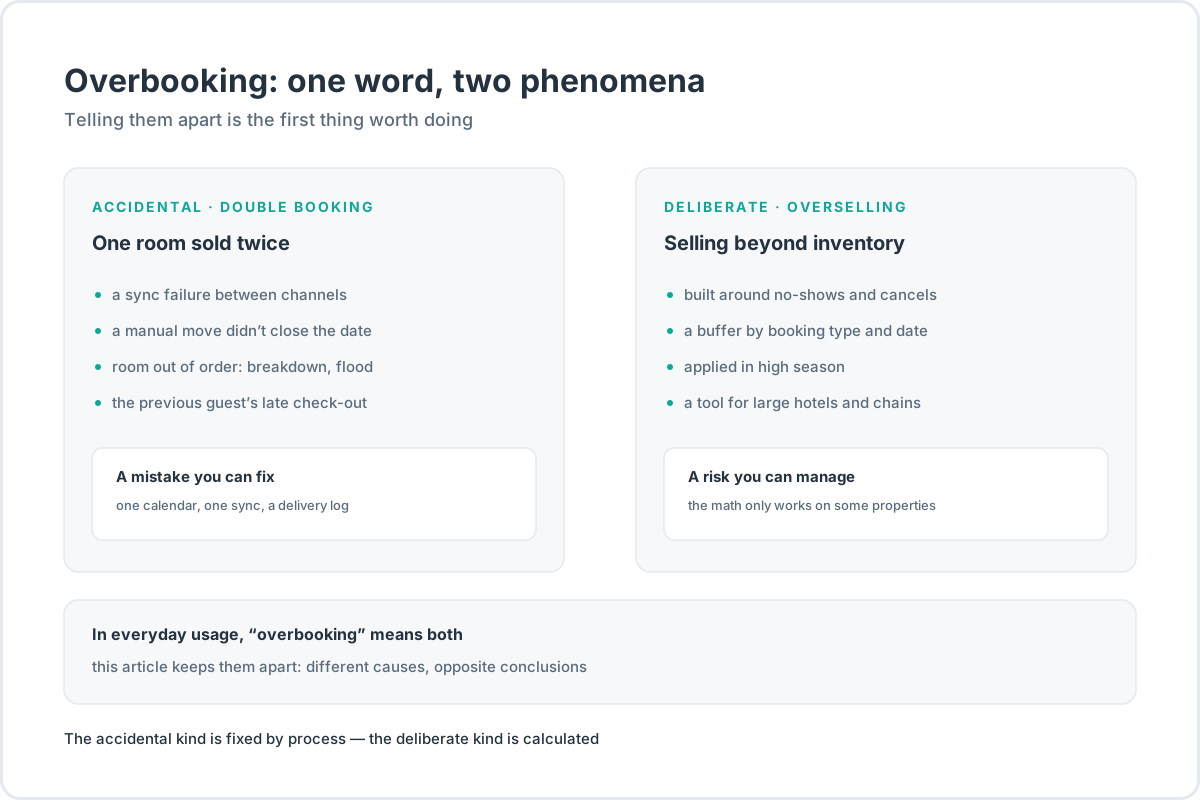
In English, the two are formally separate terms: a double booking is the accidental sale of one unit twice; overbooking is the strategy against expected no-shows. Everyday usage smears them back together — “avoid overbooking” and “practice overbooking” are written about different things. Here they stay apart: the conclusions are opposite — the accidental kind is treated with calendar hygiene, the deliberate kind is a bet that may not land.
Accidental overbooking: where a double booking comes from
The mechanics are simple: a date has as many versions of its availability as there are calendars selling it. With one channel, there is nowhere to err. From the second calendar on, a window opens between a booking in one channel and the date closing in the rest — and if a second guest slips through it, both get confirmations. How that window works and what sync does to shrink it — in the article on the Channel Manager.
Even automatic sync does not close the window to zero — a fact to accept, not a defect. Booking.com writes it plainly: changes between the Extranet and a channel manager are processed for up to five minutes, and calendar sync is not instant — updates can take up to two hours. If two guests book the last room in two channels inside that short window, both bookings can go through. The conflicting booking goes into handling — better met in the Planner in the morning than at the desk in the afternoon.
The other causes are the ones any channel connection has: updates on a schedule rather than on an event; a room-type mapping error after a rename; a price edited by hand in the channel’s dashboard; a one-way flow, where bookings come back by email; a delay on the channel’s own side. What an OTA (online travel agency) is and why channels compete for the same room — in a separate article.
Some causes sit outside sync entirely: inventory for a date shrank after the sales had gone through. A pipe burst in Room 209 — the room went into repair, and the booking on it stands confirmed. The previous guest ran late on check-out — the next one arrives in an hour. A booking from the website sat in the spam folder and was confirmed after the counter-booking from a channel. An accidental double booking is nobody’s scheme — it is two pictures of one inventory disagreeing. The scheme is the next section.
There is a calendar pattern too: peak season is also the season of double bookings. The more often bookings arrive, the shorter the average pause between them — and the likelier that two fit into one unclosed window. Off season, a conflict is nearly impossible: the room doesn’t sell twice in one evening.
What a night you can’t cover costs
If the conflict can’t be closed inside the inventory, the guest gets moved to another property — in industry terms, walked. Don’t confuse the walk with a walk-in — a guest without a booking who shows up from the street: a walk is a guest with a confirmed booking whose room wasn’t there.
The property’s obligations here settled into a standard that matches Booking.com’s official protocol for double bookings: move the guest to accommodation of the same or a better standard; if nothing is free — find it at your own expense and cover the difference in price; arrange transport or reimburse it. The channel reserves the right to book the alternative itself, at the property’s expense. The guest’s rights rest on the contract, consumer law and the channel’s rules — countries differ, so in a disputed case, check local law.
Now the numbers. The teaching example from the Cornell School of Hotel Administration: a walked guest costs about $300, an empty room about $100. In revenue management this figure has a name of its own — cost of walk. Industry reviews converge on $200–500+ in direct costs per incident: alternative accommodation, transport, compensation.
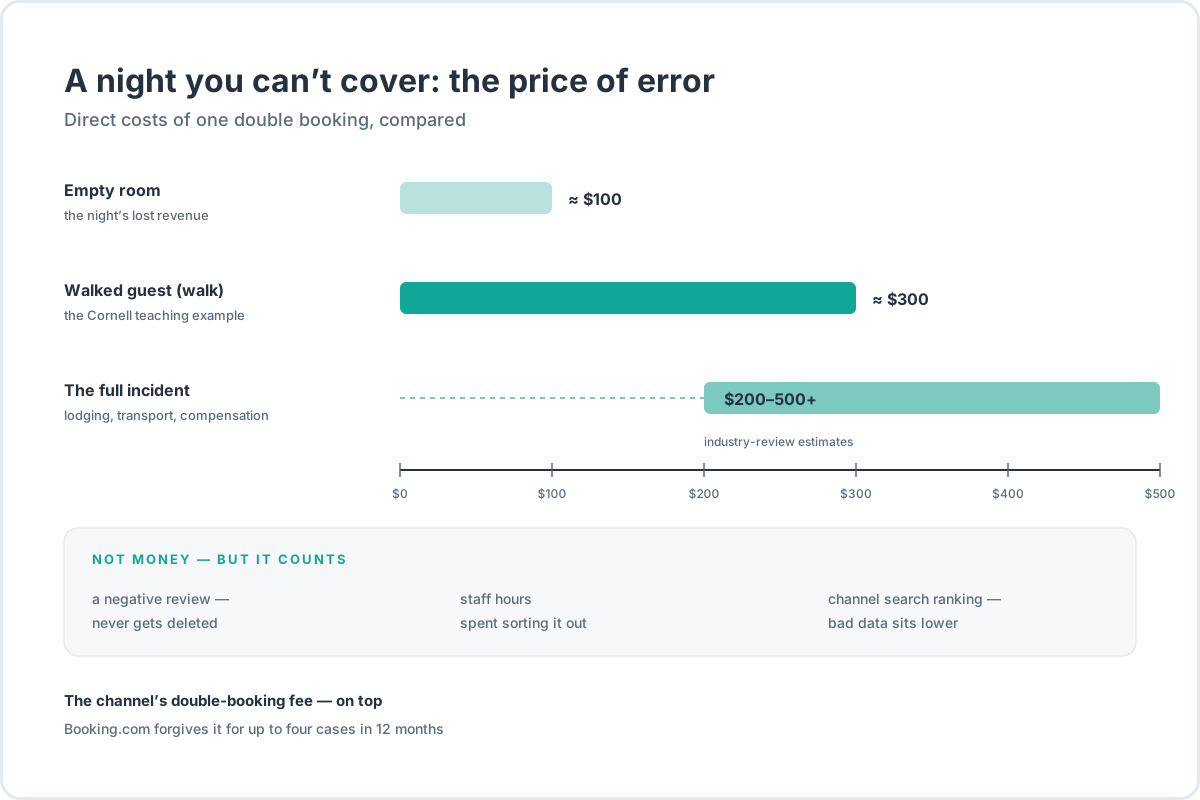
Beyond the direct costs come the ones nothing returns. Channel commission: Booking.com doesn’t take one on a double booking — but only while there have been no more than four cases in 12 months, or while the property has been on the platform for less than 30 days. That threshold is not random: past the fourth double booking in 12 months, the leniency ends and the commission starts applying. Reviews: a walked guest tells the story of that evening more often than a satisfied guest tells of a good check-in — and the review doesn’t get deleted. Ranking: channels push properties that regularly show inaccurate data down the list — frequent double bookings hit visibility. And walk-ins: an inventory sold to the brim leaves nothing for the traveler who shows up in the evening off the street, ready to pay by card at the desk.
A separate line is reputation with the channel. A platform that regularly receives double bookings from a property starts treating it as an unreliable partner: slower to answer, less trust in its data, weaker placement. Not a fine — but you pay all the same.
The last thing — how it sounds to the guest. To the hotel, a double booking is a technical error, an accident, a glitch. To the guest, it is “we were lied to”: the confirmation existed, the money existed, the plans existed. The price of communication grows out of that gap. One formula works: own the mistake at once, name a ready solution, carry the costs yourself. “We’re sorry — we sold your room twice; here is the alternative, on us” is unpleasant, but it closes the matter. A vague “system problems” and a promise to “figure something out” is a guaranteed bad review — even if the guest ends up in a better room than they booked.
Deliberate overbooking: airline math that doesn’t transfer
The idea of overselling inventory came from aviation — which is why it gets retold wrong so often. For airlines, selling more tickets than seats is allowed and regulated: in the US, federal oversales rules make compensation mandatory when a passenger is bumped involuntarily; in the EU, Regulation 261/2004 sets payments of €250–600. The denial itself is rare: about 0.25 passengers per 10,000, by US Department of Transportation figures.
The key difference lost in retellings: airline compensation is regulated by law. Hotel obligations are not. That same Regulation 261/2004 lays duties exclusively on air carriers — it does not apply to hotels. A hotel’s obligations in an oversell grow out of the contract, consumer law and the rules of the channels. There is no separate “overbooking law” in most countries: the practice isn’t explicitly banned, but liability for an unfulfilled booking stays. And “just apply the airline numbers to hotels” is an error that turns expensive the moment it becomes the basis of a calculation.
When the math works
As a calculation. Take the property’s own history: the no-show share among confirmed bookings — separately for unguaranteed bookings and those guaranteed by card or deposit, separately by dates and seasons. Then the buffer: if on a hundred rooms history says “three won’t show,” you sell 103 for the date — and on average, occupancy converges. The whole structure stands on one assumption — that “on average” arrives. On large inventories it does; on small ones the lottery begins — more below.
An honest treatment, without demonizing — the strategy genuinely works. But on its own terms:
- The inventory is large, and no-shows on it are statistically predictable. Usually 1–5% of guests don’t arrive; broad estimates for urban business hotels run up to 5–15%; the full cancellation rate on bookings reaches 40% on average by 2026 benchmarks.
- The buffer is built by booking type and date, not as one number. Channel bookings with free cancellation cancel roughly twice as often as direct ones — 21.8% versus 10.6%, by an industry report on 90+ million bookings from 2025 — so it is the flexible dates that get sold past inventory, not all bookings alike.
- It is applied in high season, when the price of an empty night is at its maximum and walking a guest costs less than the missed sale.
- Whom to walk is decided in advance. The candidates are flexible channel bookings with short stays. Loyal guests, those who paid more, and groups that can’t be split are left alone.
- The staff is trained, and walking agreements with neighboring hotels keep the alternative’s price under control: a vetted property at an agreed rate beats hunting for a room in a panic at eleven at night.
This is revenue-management methodology; hotel schools teach it. It works — on large samples.
Why a 9–30-room property usually misses
The sample is small. On ten rooms, your “no-show statistics” amount to one guest, or none. A forecast that converges to the average on 400 rooms is a lottery on ten: the no-shows come all at once, or not at all.
There is no cushion. A chain has a sister property across the road — the walk becomes nearly internal, nearly free. An independent hotel in peak season looks for the alternative from scratch, at market price, on top of the compensation.
The cost of an error is disproportionate. A walked guest runs roughly three times an empty night — the Cornell example above — and for a small property one such case is the event of the month and ready review material. For a 300-room chain it is working noise; for a property whose whole room type is three rooms, it is an incident guests remember longer than a good breakfast. Loyalty is the main asset of a property that lives on repeat guests and word of mouth; spending it to insure against one no-show is a bad trade.
A 100% occupancy happens only when the forecast lands exactly. Off by one guest — and you pay under the protocol from the previous section.
The honest alternative for a small inventory is to insure against cancellations with rates, not overselling. Sales restrictions — minimum stay, closed dates, non-refundable rates — protect revenue without creating conflicts: how to assemble them — in the article on pricing your rooms. And the decision of “how much to insure” is made on future sales — OTB, the bookings already on the books for dates ahead: how to read them — in a separate article.
Preventing the accidental kind: what actually works
With the accidental kind everything is more prosaic — it is treated with calendar hygiene. In order of payoff:
- One calendar. Availability is computed from a single source: the last room of a room type sells — every channel shows zero for that date. That is the Channel Manager’s job — how it is built and how to choose one.
- Don’t edit prices in the channel’s dashboard while sync is running. An edit around the system is the most predictable cause of a conflict: at the next export, the system sends its own data and overwrites yours.
- Check room-type mapping after renames. Changed a room type’s name or capacity — open the mapping to the channel and make sure the data goes to the right listing.
- Read the delivery log. A channel behaving strangely — the log first: which channel, which period, which status. Support second. Half of all “failures” resolve with a resend.
- Close dates, don’t hide inventory. A stash “just in case” is a half-sold weekend. If the property needs the date — repairs, your own event — it closes with a restriction, and the channels get zero. How to assemble restrictions — in the article on rates.
- An evening sweep of tomorrow’s arrivals. A minute with tomorrow’s Planner — and the “Room type · N/M” counter shows at once that more is sold than exists. A conflict found at night is an administrative story for the morning; the same conflict found at two in the afternoon at the desk is $200–500+ and a review.
The conflict happened anyway: a protocol
Suppose the worst has happened: tomorrow is arrival day, and there are more bookings than rooms. Work the steps.
1. Find the conflict early. The earlier it is caught, the cheaper it settles. In the HotelsCalendar Planner it shows itself: an “Overbooking” alert and a red frame around the row. In the Channel Manager — the “Needs attention” queue: events that need a manual decision.
2. Close it inside the inventory. Click the conflict — and the booking moves to a free room of the same room type. No free room in the room type — the conflict can’t be closed inside, and this is walking territory: step 4.
3. Remember the protection on channel bookings. Bookings from channels, group bookings and bookings of five or more rooms are not moved by dragging — protection from desync with the channel: the system won’t let you “resolve” a conflict the channel never hears about; changes go through the booking card.
4. If there are no rooms at all — walk by the standard. A property of the same or a better class at your own expense, the price difference on you, transport arranged or reimbursed. In the channel’s dashboard, the booking gets flagged as a double one — at Booking.com that is a separate scenario, and the platform may offer the alternative itself, at your expense. A good habit: agree on mutual walking with two or three neighboring properties in advance — there is no time to negotiate mid-conflict.
5. Tell the guest before they arrive. A call the day before, with an apology and a ready solution — an unpleasant minute for both sides. A line at the desk and “we’ll figure something out” is a scene, a review, a ruined evening. The script: state the cause honestly, the solution concretely, name the compensation yourself — don’t wait for the guest to name theirs. Apologies and compensation are market practice: the industry norm is a night’s accommodation plus travel.
6. Debrief the cause. The delivery log will show which event didn’t arrive or arrived late. One case — fine; a series means the process is broken, and worth fixing before the channels start trusting your data less.
How this looks in HotelsCalendar
The boundary first: deliberate overselling is not our feature, and we won’t pretend otherwise. We work on the other side of the topic — making accidental double bookings rare and their resolution cheap.
Availability, rates and restrictions live in one PMS calendar and flow out to the channels automatically — two years ahead, restrictions bundled with the prices. Closing a date zeroes the quotas in every channel with a single edit. Every connection has a status: active, paused, error. The delivery log shows the channel, the period and status of every export, and a sync of all channels can be forced with one action. New bookings from channels land in the Planner on their own, with the channel’s name on the booking bar — no re-checking whether the email arrived.
In the Planner, the conflict doesn’t hide: the “Overbooking” alert, the red frame around the row, a click — and the booking sits on a free room of the same room type. A move inside the inventory is the cheapest resolution there is: the guest keeps the room type, and the property pays not a cent of direct costs. Channel and group bookings are protected from dragging — they are changed through the booking card, so the channel isn’t the last to learn. The “Needs attention” queue collects channel events that need a manual decision — with a counter, so you don’t hunt across the channels’ dashboards.
And honestly: channel races are possible even with sync — the window shrinks from hours to minutes, but not to zero. The conflicting booking goes into handling and is resolved in the Planner, not over the phone with the guest. The formula is simple: a double booking should be a one-off incident, not a daily lottery.
To see it working — the Channel Manager page.
The takeaway
- Overbooking is two phenomena: an accidental double booking (a failure) and a deliberate oversell (a strategy against no-shows). Different causes, opposite conclusions.
- The accidental kind is treated with hygiene: one calendar, availability sync, clean room-type mappings, the delivery log.
- The price of an error: a walked guest about $300 against about $100 for an empty night, $200–500+ for the full incident, plus the channel commission and the review.
- Airline math doesn’t transfer: with airlines, compensation is regulated by law; with hotels, obligations grow out of the contract, consumer law and the rules of the channels.
- For a 9–30-room property a deliberate oversell usually doesn’t pay: small sample, no neighboring-property cushion, a disproportionate cost of error. Insuring with rates is the more honest move.
- The protocol for a conflict: find it early, close it inside the inventory with a click, walk by the standard at your own expense when rooms run out, tell the guest before they arrive.
Frequently asked questions
Sold a room twice — what now?
Find the conflict early — in the Planner it shows as an “Overbooking” alert and a red frame around the row. A free room of the same room type — click the conflict and move the booking; channel bookings are changed through the booking card, not by dragging. No room — walk the guest to a property of the same or a better class at your own expense, with transport and compensation, and flag the booking as a double one in the channel’s dashboard. If the guest is already at the desk — one priority: check them in or walk them; the causes come after. How the PMS shows such conflicts — on the product page.
Is overbooking legal?
In most countries there is no explicit ban, but “not banned” doesn’t mean “without liability”: obligations to the guest arise from the contract, consumer law and the rules of the channels. On channel bookings, the channel’s protocol applies — Booking.com, for example, requires moving the guest to accommodation of the same or a better standard at the property’s expense. In disputed cases, check local law. How channels and their rules are built — in the article on OTAs.
What’s the difference between overbooking, a double booking and overselling?
A double booking is the accidental sale of one room twice — a failure. Overselling is the deliberate sale of capacity beyond inventory, betting on no-shows and cancellations. Everyday writing calls both “overbooking.” In practice, the accidental kind is removed with sync — how that works — and the deliberate kind isn’t used at all on a small inventory.
Does Booking.com charge a commission on a double booking?
It doesn’t, provided either of two conditions holds: the property has been on the platform for less than 30 days, or there have been no more than four double bookings in 12 months. Over the limit, the commission applies — one more argument for fixing causes instead of dousing symptoms. Reviews and ranking suffer with regular double bookings regardless of the commission; how channels rank properties — in the analysis of OTA ranking algorithms.
Why do double bookings happen even with sync?
Sync has a delivery time, and part of it belongs to the channel itself: Booking.com processes changes between the Extranet and a channel manager for up to five minutes, and calendar sync can take up to two hours. Two bookings inside one window — both confirmed, the conflicting one goes into handling. Sync’s job is to make that case a one-off, not a daily event: how it is built.
Should a small hotel deliberately oversell its inventory?
Usually, no. At 9–30 rooms the no-show statistics never reaches forecasting volume, there is no neighboring-property cushion, and one walk costs roughly three times an empty night — plus the review and the channel commission. Insuring with rates is more reliable: sales restrictions, non-refundable rates, a deposit guarantee — how to assemble that.