

Notes for hoteliers
Metasearch and Google Hotel Ads: how a hotel gets into the price comparison

Hanna Auramenka / Pexels
The owner of a fourteen-room hotel repeats the same ritual every week: open Google, type in the hotel’s own name. Photos, there. Reviews, there. Phone number, correct. And under the card—a price block with several rows: Booking.com, Expedia, one more channel. The hotel’s own website is nowhere among them.
The guest who runs the same search tomorrow sees the same screen—and clicks the top row, not out of disloyalty, but because that is how the screen is built. The booking happens on the channel’s platform; the commission on it is paid by the hotel. The block itself is called metasearch—and it is not a sales channel at all but a comparison storefront that, on the face of it, sells nothing. Let’s unpack what metasearch is, how it earns, what in it is free, and how a property with 9–30 rooms gets into the price comparison under its own name, not a channel’s.
Metasearch in plain words: it compares, it doesn’t book
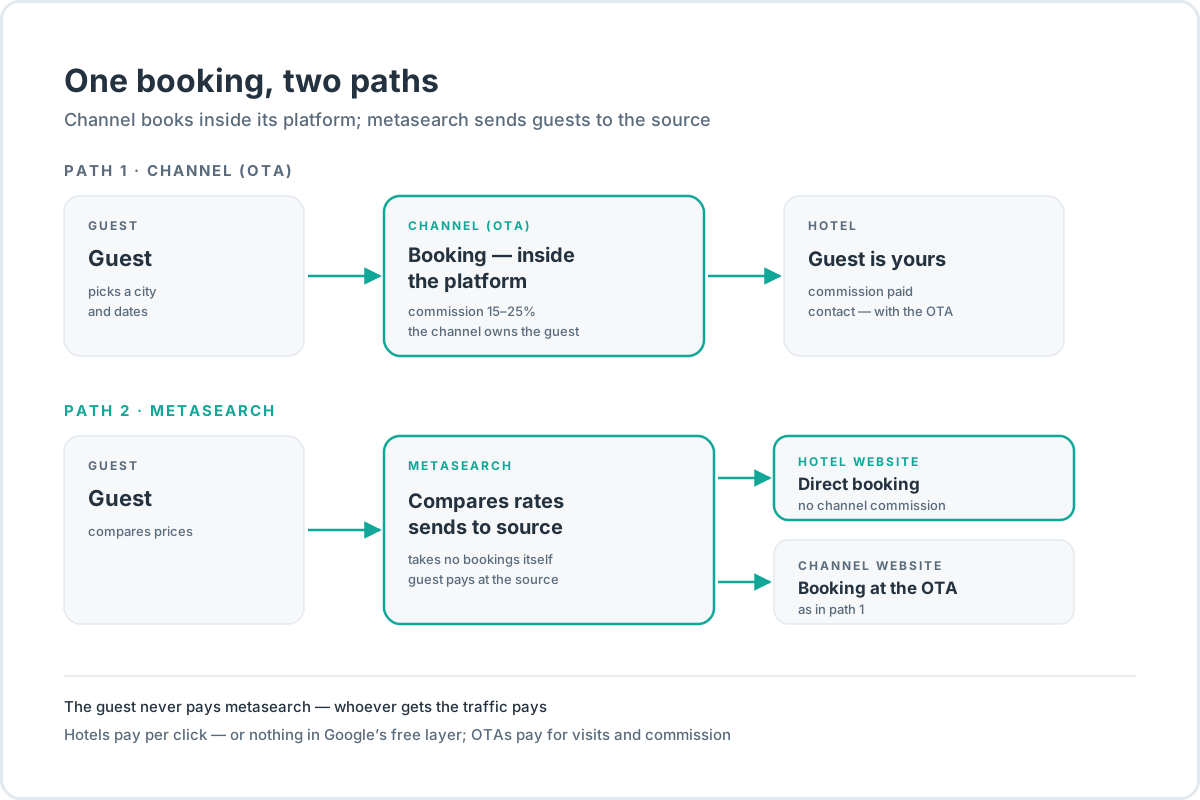
Metasearch is a price aggregator. It gathers rates for the guest’s dates from several sources at once—the channels and the hotel’s own site—and lays them out in one list: who is cheaper, whose cancellation terms are softer, who throws in breakfast. Then the guest chooses, clicks, and goes wherever they will pay. The booking completes on the source’s side: the channel’s platform or the hotel’s booking page. The metasearch engine itself does not book, does not take payment, does not send a confirmation. Kayak says it outright: the service doesn’t handle bookings and doesn’t process payments.
That is the main difference from an OTA (online travel agency). An OTA is a point of sale: the booking happens inside the platform, for a commission, and the guest stays the platform’s customer (what follows from that—in the article about OTAs). Metasearch is a storefront: it sells not rooms but the click. And the money in this construction sits elsewhere—not with the guest, and not always with the hotel, but with whoever needs the traffic.
Who pays whom in metasearch:
- OTAs—for clicks and promotion: a guest comparing prices sees their rows among the first.
- The hotel—per click or per booking, if it turns on the paid layer. Or not at all: Google has a free one—a whole section below.
- The guest—pays no one, ever. Kayak phrases it as a principle: revenue comes from partners, not from travelers.
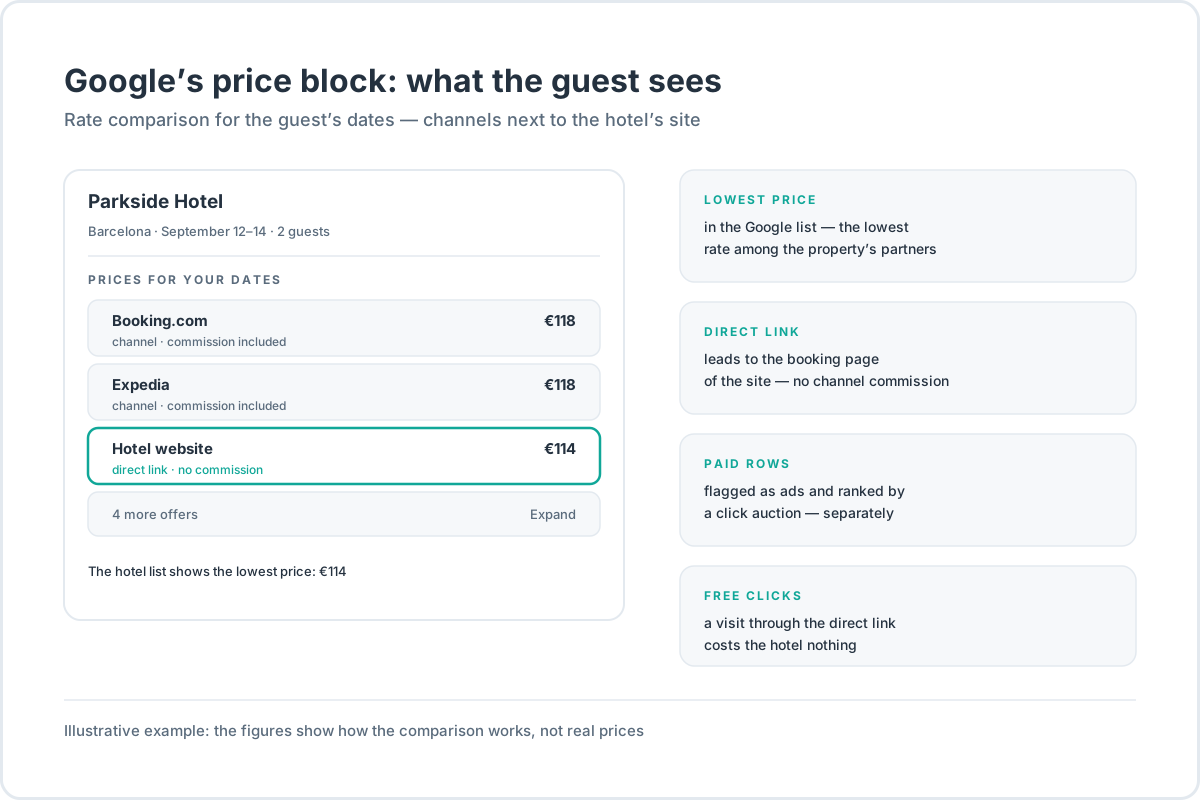
Walk through the screen. A guest searches “hotel in the city center, September 12–14, two guests.” In Search and in Maps, the property card unfolds a price block: several rows, each with a source’s name and its price for those dates. Click the Booking.com row—the booking completes on Booking.com, commission on the hotel. Click the hotel’s own row—the guest lands on your booking page, and the booking is direct. Metasearch did the same thing in both cases: showed the comparison, pointed the guest to a source. What came next depended on whose row won.
Five metasearch engines—and who owns them
Five global metasearch engines matter to a hotel.
Google Hotels—not a separate site but a layer inside Google: the price block in ordinary Search and in Maps. For most properties it is the main metasearch, for one simple reason—the guest starts the search here. Paid promotion goes by the name Google Hotel Ads; reports on rates and links live in the Hotel Center dashboard.
Tripadvisor—the case where metasearch is built into the review card. The guest never opens a separate “price comparison site”: they read your property’s reviews, and underneath unfolds a price block for their dates—channel rows and, when the hotel’s rate is connected, your direct one. For a hotel it is the second metasearch by weight after Google: hundreds of millions of visitors a year come not to hunt prices but to read reviews—and the comparison assembles itself around them.
Trivago—a classic lodging price comparer. Majority owner: Expedia Group—and by Trivago’s own annual reporting, the lion’s share of its revenue is advertising for the Expedia brands.
Kayak—search for the whole trip: flights, hotels, cars. It belongs to Booking Holdings—the same group as Booking.com.
Skyscanner—flight and hotel search, bought by Trip.com Group in 2016.
A fact is hiding here, and it explains half of how the results look. Trivago belongs to Expedia and mostly lives on its advertising; Kayak belongs to Booking Holdings. Google is its own case: its metasearch is a way of keeping trip planning inside Search. Tripadvisor is special differently: it belongs to neither OTA group, but it lives on their advertising—Booking and Expedia account for about a fifth of its 2025 revenue. The OTA rows in the comparison are always within reach not because someone is cheating, but because the arrangement pays everyone involved. Prepare for the sight in advance: your direct price in metasearch competes with the prices of the very channels that finance the storefront.
| Metasearch | Owner | Who completes the booking | Paid models for the hotel | Free layer |
|---|---|---|---|---|
| Google Hotels (Search and Maps) | the source whose row the guest clicked | Hotel Ads: pay per click—fixed bid, a share of the booking, or target-ROAS optimization | free booking links: clicks at no cost, placement not for sale | |
| Tripadvisor (metasearch inside the review card) | independent public company (grew up inside Expedia, separate since 2011) | the source | Sponsored Placements: pay per click, impressions free; the hotel’s rates—via a connected provider | the review card, its rating, and managing it—free |
| Trivago | Expedia Group (majority owner) | the source | Rate Connect: a 12–25% commission at the property’s chosen rate, charged after check-in; or pay per click | a separate “free booking links” product |
| Kayak | Booking Holdings | the source; the “Book on KAYAK” mode completes a third-party provider’s booking | pay per click or per booking, sponsored placements | — |
| Skyscanner | Trip.com Group | the source | auction model, connected through partners | — |
One caveat about Kayak—its booking mode is easy to mistake for an exception. “Book on KAYAK” completes the booking right on the metasearch site, without a jump to the source’s tab. But even then a third-party provider processes the booking: metasearch stays a storefront, not a seller. None of the five claims to “book it itself”—not modesty, business model.
Tripadvisor: prices on top of reviews
Tripadvisor is built like the others, but the entrance is different. The guest comes to read reviews, not to compare prices: the platform holds more than a billion reviews and opinions covering nine million hotels, restaurants, and attractions, and hundreds of millions of visitors a year make it the first step of choice. The price block for the guest’s dates unfolds right in the property card—under the rating, next to the reviews. Comparison gets built on trust: first the guest picks by reviews, then checks who is cheaper.
The money works the familiar way—a click auction. The largest source of Tripadvisor’s hotel-segment revenue is partners paying for clicks on their price rows; the bids are played out in an auction, paid by channels and hotels alike. The product for hotels is called Sponsored Placements: you pay only for the clicks, impressions are free, and your ad is shown to people searching for a place to stay near you on dates when you have availability. The hotel passes its rates into the block through a connected provider—the same pattern as Google’s. The card itself—reviews, rating, photos—and managing it are free. But there is no free layer at Google’s level here: the card is free, not the display of your price. Without the hotel’s rate, the price block in its card works for the channels.
For a small property the takeaway is plain: run the card and the reviews—that is the storefront your prices show on. In Tripadvisor’s own research (23,000 travelers, 12 markets, 2019), 79% would rather pick the higher-rated property all else equal, and half would not book a property with no reviews at all. Reviews collect the clicks on prices; an abandoned card hands the price block to the channels.
One honest caveat to close. Tripadvisor tried twice to become a booking point—and rolled both attempts back: the Tripadvisor Plus traveler subscription was closed in 2024, and the Instant Booking mode was switched off in April 2026 (even there, bookings were processed by a third-party provider). Today it is a storefront of click-throughs—like Trivago and Kayak, only built on top of its own review ranking.
What metasearch charges for: clicks, commissions, an auction
Paid metasearch is mostly an auction for the click.
Pay per click (CPC, cost per click). Want your row higher in the paid block—outbid the neighbor. The guest clicks, you pay, whatever happens next. No booking, closed tab, wrong dates—the money does not come back. This is the base model of metasearch: Trivago’s own reporting calls its revenue “primarily cost per click.” For a small property, that is the paid layer’s main risk: you pay for attention, not for bookings.
Commission per booking (CPA). More honest by design: you pay only for a completed order. At Trivago it’s Rate Connect—the property picks its rate from a grid of 12, 15, 18, 20, or 25 percent of the direct booking; the charge comes after a confirmed booking that lives to the guest’s check-in, and clicks are not billed at all. The back-of-the-napkin arithmetic: twenty direct bookings at €300 with a 15% rate is €900 in commission after the check-ins—and zero for the clicks before them. Kayak has a per-booking model; Skyscanner’s commissions connect through partners.
The free model. Exists—and only at Google. The next section is entirely about it.
Now the footnote that saves you from old guides. Google Hotel Ads once ran commission campaigns too—a percentage of the booking, or pay for a completed stay. Google closed them to new participants on April 30, 2024, and switched them off fully by February 20, 2025. Paid Google today is clicks only: a fixed bid, a percentage bid, or optimization toward a target return on ad spend (Target ROAS). If an article promises a “Google commission of about 10%,” it was written before these events and doesn’t know today’s Google.
The channel economics, for contrast with an OTA. Per an industry report (a thousand hotels across Europe and Asia, 2022 data), paid Google metasearch cost hotels about 8% of channel revenue—and 5.2% with the free links counted in. A channel commission starts at 15% and runs to 25%. Now add the booking value: the average direct booking brings $516 against $312 from a channel (industry report, more than 135 million bookings, 20 markets). Metasearch does not make a booking direct by itself—but a direct booking that arrives through it costs markedly less than a channel one.
Google free booking links: what is free and what is paid
Since March 2021 a free layer has run inside Google’s price block—free booking links. The mechanics: your prices and a direct link to your booking page appear in the comparison—no cost per click, no commission, no fee for placement. Google announced the launch separately, with wording worth quoting almost verbatim: there is no charge for clicks on free booking links—and no one can pay for a higher ranking in them.
Three clarifications come attached. Without them, “free” sounds too good.
First: the free layer is open to every partner type—from individual hotels to online travel agencies. Right next to your direct link, in the same block, Booking.com’s and Expedia’s links stand free—with their commission baked into the price. That is not a glitch; that is the product. Comparison is what metasearch is. The free link does not cancel your competition with the channels—it gives you the right to compete without an entry ticket.
Second: placement in the free layer is not for sale. What the free link ranks on: user preferences, the value of the offer, landing-page quality, historical price accuracy. Paid promotion (Hotel Ads) is a layer above—its rows are labeled as advertising and played out in a click auction. Free and paid links show side by side but rank separately: a place in the free row cannot be bought at any price.
Third: at the list level, the lowest price rules. While the guest scans many hotels at once, Google shows each property’s row at its lowest rate among all partners. If a channel is cheapest, the list shows the channel’s price—your terms open only inside the property card. Your price drifting from the channel’s cancels half the point of the free link: the guest clicks wherever it is cheaper.
Does the free layer work, in numbers? Industry-report data for 2022: 3.66% of clicks on free links turned into bookings, against 4.10% for the paid ones. The average booking value is lower—€258 against €329—but the channel costs nothing, and free links brought 34% of all Google metasearch revenue in the sample. Another 68% of those bookings came from mobile. An estimate from 2023–2024 industry data gives free links 15–16% of Google metasearch traffic at a conversion roughly 60% below paid—the data isn’t fresh, but the conclusion holds: the free layer doesn’t replace the paid one; they work as a pair. Turn on both—the free one first, because it costs nothing.
What connection takes: a rate feed and a landing page
There are two technical conditions. Both come from Google.
The first is rates: prices and availability for the dates must flow to Google as a separate stream—a rate feed. The second is a landing page: the link has nowhere to lead if your site has no booking page where the guest sees their dates and price. Everything else is a question for whoever ships the feed.
Until July 2025, a small hotel could submit rates on its own: through its business profile, free, no middlemen. On July 30, 2025, Google closed that path. The only way in now is a provider: a central reservation system (CRS), a booking engine on your site, or a PMS (property management system). Google’s help pages put it as advice: ask your provider—they may be able to set up your booking links for you. The same pages hold the catalog of providers that submit rates—not only PMSs and booking engines but channel managers too. And a hint few know: you may already be connected—before buying anything, check with your current provider.
Hence a practical criterion for choosing a booking engine, if you haven’t chosen one: can it send rates into Google metasearch? Not “we have a beautiful widget,” but “prices go into the feed, the link leads to a live page with dates.” How to choose an engine on all criteria at once—in the separate guide.
The other half of connection is price accuracy. Google demands accuracy, not parity: the full price on the landing page must match the feed. The penalty ladder is stepped: Fair and Poor—fewer impressions and a worse position; At Risk—most links switched off; Failed—all of them. Since September 29, 2025, filtering of inaccurate prices has been tightened for ads and free links alike; and since February of the same year, the final price and availability must be confirmed before the guest is asked for personal data. Manual price edits lose to an automatic feed—not to laziness, to arithmetic: a price that has been off for two hours costs you impressions. Google’s best practices fit on three legs: correct property matching, accurate prices, a friendly landing page.
And the trap everyone remembers last. Your direct price is compared against the channels in the same block. If your site is more expensive, the guest leaves for the channel—and the free link starts working for the channel: it honestly confirms that Booking.com is cheaper. Keeping prices convergent is the Channel Manager’s job: updates go out to the channels automatically, quotas are computed from the single PMS calendar. The full walkthrough—in the Channel Manager guide. On parity, and why in the EU you may price lower on your own site than the channel’s—in the article about OTAs; here one thing bears repeating: metasearch doesn’t demand parity. It demands that the price match your own.
Is the channel growing: the 2025–2026 numbers
The metasearch audience for independent hotels is no longer a hypothesis—it is measured. In summer 2025, Google Hotel Ads entered the top five booking channels of Europe’s independent hotels for the first time: an industry report on 600,000+ bookings from two thousand properties across six countries. Per the industry distribution report, metasearch is hotels’ fastest-growing advertising channel, +69.3% against 2019; over the same years, the direct share of independent properties’ revenue grew from 23.6% to 29.5%. And not only Google: Trivago closed 2025 with revenue up 19%—five strong quarters in a row for a platform selling hotels their clicks. The “death of metasearch” talk does not survive that number.
Now, AI—the question every second owner asks. In August 2026, Google switched on hotel booking inside AI Mode: conversational search, room selection, cancellation terms, payment. Read the footnotes, not the headline: US only, English only, the European Economic Area (EEA) excluded—and Google itself does not become the seller; that stays with the hotel or the platform the booking runs through. For a European property, what changes so far is not the payment channel but the point of discovery: the guest starts the trip with a question to an AI more often than with a list of links.
Measured, too. Adobe counts traffic from AI tools to travel sites up 2,215% since October 2024, those visitors’ conversion already approaching the ordinary. The counterpoint is from data, not hype: the 2026 industry report records that AI has not yet altered the distribution balances, and 135+ million bookings confirm it—the channel share in 95% of markets moved by no more than 1.5 percentage points in a year. Put it together: a rate feed is raw material not only for today’s price comparison but for tomorrow’s AI storefronts feeding on that same feed. Being in the feed is the condition for being present in both worlds. Missing the moment it becomes mandatory is a way to be absent from both.
Is it worth it for a small property: an honest walkthrough
Metasearch works for a property that already has something to compare and somewhere to lead.
When it works:
- a live booking page—the link leads to a site where the guest finishes the purchase, not a “call us” page;
- the price on your site is no worse than the channel’s—otherwise the link works for the channels;
- the channels are synchronized—the feed lies about neither price nor availability.
When it is early:
- no booking engine—the direct link has nowhere to lead, and the impressions go to the channels entirely;
- prices are edited by hand and drift from the feed—price accuracy drops, impressions get cut;
- the site is not ready for mobile traffic—and 68% of bookings on free links come from phones.
“Early” is not a verdict; it is an order of steps. Metasearch is not a property’s first purchase but the fourth or fifth: a PMS and rates, the channels, a site with a booking engine—only then the price comparison. How to build that sequence and what to buy first—in the article on software for a small hotel.
Paid campaigns call for a separate honesty. Starting with them is like buying ads for a shop with no storefront. The free layer comes first: it costs zero and shows whether anyone searches your name in a comparison at all. Then two roads. A small-budget test on clicks—ready to pay for off-target visits until your booking page learns to convert. Or commission-based Rate Connect: risk-free in the sense that you pay only for bookings that live to check-in—but the 12–25% rate must fit the room’s economics, or the direct channel stops differing from an OTA.
A last caveat, without which the picture would be an ad. Metasearch does not replace the channels. Channels hold 63.4% of bookings at independent properties (industry report, 90 million bookings in 2025), and that volume is going nowhere. Metasearch is a way to meet the part of demand that already compares prices, without the channel commission. Not a silver bullet—one more storefront, and this one’s entry ticket can cost zero.
How this looks in HotelsCalendar
The Booking Engine is the landing page in this picture. The widget embeds into a site with two lines of code; the guest books in three clicks; the booking page opens in eight languages; card payments run through Stripe. A booking from the site lands in the PMS Planner on its own—no manual re-entry.
The free layer is Google’s machinery, and rates reach it through a provider: a central reservation system, a booking engine on the site, or a PMS. The ability to send a rate feed is one of the criteria for choosing an engine at purchase. What we don’t do and don’t promise: no paid campaigns, no selling positions in the price block, no promises of traffic—impressions and clicks are Google’s to decide; the software bill holds the subscription only, no commission on bookings. Promotion is a market mechanic: a click auction run by the property or its agency. And so that your direct price doesn’t lose to the channels in the same block, the Channel Manager keeps prices there current—changes go out automatically from the single calendar. The rest—site, payment, booking into the Planner—is covered by the Booking Engine.
The takeaway
- Metasearch compares rates for the guest’s dates from the channels and from the hotel’s own site; the booking completes at the source. The guest never pays metasearch.
- The money is in the paid layer: pay per click almost everywhere; on the metasearch commission programs, the rate runs 12–25%. Google’s commission rates have been closed since February 2025.
- Google free booking links—the property’s prices and a direct link, with no cost per click; the ranking is not for sale; the channels stand free in the same block, right next to you.
- Tripadvisor is metasearch inside the review card: the card and its management are free, the price row is a paid click; booking on the platform itself was wound down by 2026.
- The way in is through a provider: a booking engine, a CRS, or a PMS. Self-submitting rates through a business profile has been closed since July 30, 2025.
- Price accuracy is Google’s demand: the price on the booking page must match the feed. A mismatch costs impressions, not reputation.
- A small property needs metasearch after a site with a booking engine and synchronized channels—not before. The free layer is the sensible first step: it costs nothing.
Frequently asked questions
Is metasearch the same thing as an OTA?
No. An OTA books inside its platform and takes a commission; metasearch compares rates from several sources and sends the guest to the source—the booking completes with whoever’s row was chosen. The guest never pays metasearch; the receivers of traffic do. How channel commissions and settlement models work—in the article about OTAs.
What are free booking links in Google metasearch?
A way of being present in Google’s price block: the property’s prices and a direct link to its booking page, shown with no cost per click, no commission, no fee for placement. Promotion is a separate paid layer (Hotel Ads) with a click auction; the ranking of free links is not for sale. The free layer is open to OTAs too—channel links stand right next to the hotel’s direct one.
Do I have to pay Tripadvisor for guests to see my hotel’s prices?
The property card, the reviews, and their management are free—claiming the property costs nothing. The price row is the paid layer: the block lives on the clicks of advertising partners, and a hotel joins the same way—Sponsored Placements, pay per click, impressions free. Tripadvisor has no free layer at Google’s level: without your rate, the rows in your card go to the channels.
How does a hotel get into Google metasearch?
A rate feed—prices and availability by date, flowing to Google—and a booking landing page. Since July 30, 2025, Google takes no rates from hotels directly: only through a provider—a booking engine, a CRS, or a PMS. Google suggests asking your current provider first: the links may already be set up. The Booking Engine page.
Do I need a Booking Engine for metasearch?
Yes—if you want your direct price in the comparison. Without a booking page the feed has nothing to show and the link nowhere to lead: impressions go to the channels, commission inside their prices. The criterion for choosing an engine is whether it sends rates into metasearch; the full guide—in the article on the Booking Engine.
Whose price will Google show—my site’s or the channel’s?
At the list level, the lowest among all your partners: if a channel is cheaper, the guest sees the channel’s price. That is why prices on your site and in the channels must converge—a divergence works for the channel. Keeping them in order is the Channel Manager’s job.
Can I buy a position in Google’s price block?
For free links—no: the ranking is not for sale, and the paid auction’s bids don’t touch it. Paid Hotel Ads rows are a separate layer: labeled as advertising, ranked by their own rules. How to climb the rankings inside Booking.com and Airbnb themselves—a separate walkthrough.