


Notes for hoteliers
Booking.com alternatives: which channels work in which countries

Lara Jameson / Pexels
End of the month. The owner of a sixteen-room aparthotel opens the Booking.com statement and, for the hundredth time, sees the same line: commission. Napkin math: twenty-five channel bookings a month at $300 comes to about $1,125 for the base rate alone—before visibility programs and discounts. Next, usually, comes the search bar, and into it goes “Booking.com alternatives” or “where else to list a hotel.” The results answer with top-ten lists where half the entries are channels your guests have never opened, and the other half are somebody’s affiliate links.
The question is the right one. The expectations are not. A “Booking.com alternative” is not a magic channel with a 5% commission and the same flow of guests—it is a deliberate combination of storefronts matched to your geography and your inventory. This article walks through which second channel actually works in which region, what the major alternatives cost in commission, and how to assemble a mix that brings bookings instead of headaches.
Why a single storefront is a risk
First, an honest word about Booking.com itself. It is the largest booking channel in the world: in 2025, 1.2 billion room nights and $186.1 billion in gross bookings passed through the Booking Holdings group (group reporting). In Europe the channel has no equal—more on that below. Leaving it altogether is a bad idea for most small hotels, and this article is not arguing for that.
The problem sits elsewhere: when all your demand arrives from one dashboard, you are not so much selling through a channel as working on its terms. Anyone who has leaned on a single storefront for a year knows the risks by heart.
- The algorithm. Display order in search results changes without warning. A property that was on page one for its district yesterday lands on page three today—and sales fall with the same rooms and the same rates. How ranking works and which parts of it depend on you—in a separate deep dive.
- Commission. The base rate is not the ceiling. Visibility programs add percentage points on top, and loyalty-program discounts are funded by the property. Every “boost your ranking” upgrade is voluntary—but declining all of them means losing visibility.
- The rules. Cancellation terms, display order, card requirements—the platform decides all of it. You adapt.
- Outages and suspensions. A moderation error, a disputed review, an integration failure—and the flow from your only channel stops dead. Recovery takes days.
Channels are not a necessary evil, though—they are most of the demand: per an industry report on 90+ million bookings at independent properties in 2025, 63.4% of those bookings came through channels; a year earlier, 61%. The conclusion is not “leave the channels” but “don’t pool all your demand in one dashboard.” Diversification is insurance: a second channel covers a ranking dip, a seasonal slump, a commission change.
And one number for perspective. In the European Union, travelers spent 952 million nights in 2025 through three platforms—Airbnb, Booking.com, and Expedia—11.4% more than the year before (Eurostat; EU only, and only those three platforms). In the first quarter of 2026, another 144.3 million nights, up 9.7% year over year. The channel market keeps growing. The question is which slice of it reaches you, and through which storefronts.
The channel map: who leads where
Here begins the main flaw of every alternatives list: they enumerate channels as if demand were spread evenly across the globe. It is not. Every region-and-channel pairing has a leader, and the region’s second-strongest channel often is not the second entry on the list you googled.
Region by region, then—with numbers and caveats, because the short-term rental market and the classic hotel market are counted differently.
Europe: Booking.com first, alternatives after it
In Europe’s online hotel sales, Booking.com holds about 71% of bookings and the whole Expedia Group about 11% (a 2026 compilation of market data layered on a 2025 industry study). In short-term rentals the picture is the same, and it is measured country by country (AirDNA data, STR segment): Italy—about 63% of bookings through Booking.com; Spain—59%; Germany—58%; France—52%; the UK—41%. The most Booking-dependent country is Poland: about 54%, and properties listed on Booking.com alone make up 30% of the supply there while collecting 42% of the demand.
The practical takeaway is uncomfortable but honest: in Southern and Central Europe, a “Booking.com alternative” is a second tier. You need it, but the extra demand from it arrives in portions, not in a flow the size of your first channel. The second-channel bet in Europe is not “replace Booking” but pick up the segment your first channel covers weakly.
Which segment depends on your format. France is the most Airbnb-oriented market in Europe: about 70% of short-term rental listings are on Airbnb only (AirDNA). If your property is apartments or a house with character, in France and similar markets the real alternative is Airbnb, not Expedia.
The US: the only major market where number one is Expedia
The United States is the exception to the European picture. The number-one platform by OTA (online travel agency) bookings is Expedia Group, with a share of about 19% (an industry distribution report for 2025); Booking.com is second. One more American peculiarity: hotel websites sit firmly among the top channels by bookings—in 2025 the top five were Expedia, Booking.com, property websites, Agoda, and Airbnb (same report). The share of domestic bookings in the US grew by 3.2 percentage points over the year: Americans, more than Europeans, book direct in their own country.
The takeaway: if your source report shows a meaningful share of guests from North America, your second channel should almost certainly be Expedia—and your own website is not a “someday later” project but part of the mix right now.
Asia: Agoda has passed Booking
The most telling reshuffle of 2025. In Asia-Pacific hotel distribution, the number-one platform is Agoda, with a 20.9% share against 16.4% in 2022 (an industry report across 2,000+ hotels in the region). Agoda leads in Malaysia, Thailand, Singapore, and the Philippines. China is a separate story: travelers there pick Trip.com—about 69% (a 2025 industry study).
A note on Agoda, so the map stays honest: the platform has belonged to Booking Holdings since 2007. It is not an “independent rival of Booking” but a brand of the same group—with its own audience, its own demand from Asia, and its own catalog. For a property with guests from the region, that does not make the channel any less useful.
One more caveat, for completeness: in Asia the direct channel—a property’s own site—is under more pressure than in Europe; the local guest prefers to finish the booking inside a local platform. The conclusion is the same: for Asian demand, connect Agoda or Trip.com instead of hoping your site will collect that traffic on its own.
Latin America: global channels plus a local giant
Latin America is the third big scenario, and it shows better than anything why the map is worth a look. Airbnb and Expedia both work in the region, but the local leader is Despegar, the largest OTA in Latin America: in May 2025 it was bought by the international investment group Prosus for $1.7 billion. Online channels deliver more than half of bookings in Argentina, Brazil, and Mexico (industry research, 2024–2025), and 74% of Latin Americans book lodging online (a 2025 survey). A “top 10 Booking alternatives” list has nothing to say about this market. The map does.
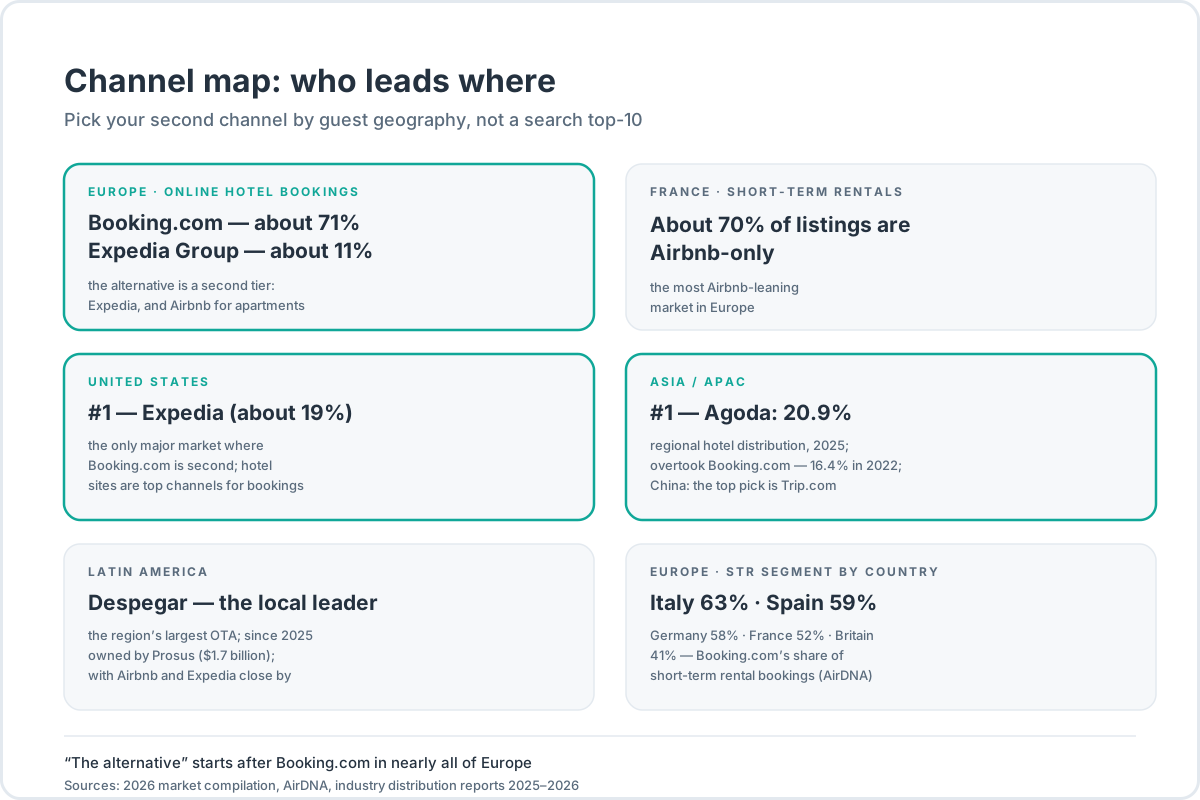
Now, what the map adds up to. An “alternative” is always the answer to two questions: where your guests come from, and in what format you sell. Not “which channel is best” but “which channel covers my geography and my inventory.” On to who’s who—and what it costs.
Who’s who: channel types and their commissions
We covered the platforms and their audiences in the OTA article—no repeats here, only what you need to choose a second channel. By structure, all the alternatives fall into four types.
Broad-reach channels. Airbnb, Expedia, Agoda—storefronts with international audiences. Airbnb: for professional listings—hotels, aparthotels, and anyone working through a PMS or Channel Manager—a single host fee of about 15.5% applies, built into the price; in this model the guest sees no separate service fee. In late 2025, Airbnb began direct partnerships with boutique and independent hotels—first cities: New York, Los Angeles, Madrid, San Francisco—with the list expanding through 2026. Expedia Group: one submission, several storefronts (Expedia, Hotels.com, Travelocity, Orbitz, and the group’s other brands); the commission is individual, usually 15–30%, around 20% on average—the exact rate is disclosed at sign-up; payment runs either through the platform’s virtual card, or the guest pays at the property and the hotel remits the commission. Agoda: an agency commission, rate quoted at connection; the point is demand from Asia.
Format channels. Vrbo (an Expedia Group brand): whole homes and family vacations, core audience in the US and Canada; in Europe the channel is noticeably weak—one line in the plan, not a European’s number-two channel. The payment model is a subscription or a per-booking commission, with terms disclosed at sign-up. Hostelworld: hostels—about 16,500 properties in 180+ countries, 6.9 million bookings in 2024. Listing is free; the base commission is about 15%: the guest pays a deposit, which the platform keeps as its commission, with the balance paid at the hostel. For a hostel, a base channel; for a classic hotel, no.
B2B channels. Hotelbeds—the largest “bedbank”: it sells not to guests but to roughly 60,000 distributors, tour operators and agencies (group annual report, 2025). A small property hardly needs it, but it explains bookings that arrive through chains of middlemen. How wholesalers and merchant models work—in the OTA article.
Metasearch. Google Hotels, Tripadvisor, Trivago—not OTAs: they compare prices across channels, including your own website, and send the guest wherever is cheaper. That is a separate layer with its own mechanics and its own budget—covered in the metasearch article. For the alternatives question, one thing matters: metasearch is the only place where your site and Booking.com are shown side by side, and the guest sees the price difference with their own eyes.
A summary table—reference points for choosing (commissions per the platforms and industry sources; rates change, and the exact figure always lives in your contract):
| Channel | Commission and model | Best fit |
|---|---|---|
| Booking.com | rate not published; market estimate about 15%, typical range 10–25% | the base channel for nearly any property in Europe |
| Airbnb | single host fee of about 15.5% for professional listings | apartments, homes, boutiques with character; France |
| Expedia Group | usually 15–30%, around 20% on average; virtual card or pay at the property | guests from North America; a second or third storefront |
| Agoda | agency commission, rate quoted at connection | guests from Asia |
| Vrbo | subscription or per-booking commission | family vacations, whole homes; US audience |
| Hostelworld | base around 15%, deposit-commission paid up front | hostels |
| Hotelbeds | B2B, net rates to distributors | bulk occupancy in the low season |
| Your own site | no channel commission | anyone with a website: adds margin and guest data |
Base versus real commission: the visibility machines
The most expensive mistake when comparing channels is to look at the base rate from a sales deck. The real commission is almost always higher, and the gap keeps growing.
The mechanics are the same across the industry. Booking.com’s Preferred Partner program adds roughly three percentage points to the base rate, and Genius discounts are funded by the property. At Hostelworld, the paid visibility program Elevate lifted the market’s effective rate from 15.8% to 17.7% in a year (data for the first half of 2026)—on a base commission of about 15%. Niche channels that look “cheap” from the outside are on the same road: the visibility machines have reached them too.
Hence the rule: compare channels by the real rate from your own statements for recent months, not by the number on a landing page. And remember that commission is not a channel’s whole cost: per industry data, 21.8% of channel bookings get canceled, against 10.6% of direct ones, and the average channel booking is worth $312 against $516 direct. How to work out your net rate after commission—in the ADR article.
How to choose your mix: four questions
The framework is shorter than any top-ten list. Four questions to answer before connecting any channel.
1. Where do your guests come from? Open the bookings list from last season and check the source of every booking—channel, website, front desk. In a PMS, each booking stores its source, and the channels offer guest-geography reports. If 60% of your guests come from Germany and 30% from the US, your mix is Booking.com plus Expedia—and no Airbnb will fill that gap. The geography of your arrivals matters more than a channel’s popularity ranking.
2. What is your inventory format? A classic 9–30 room hotel needs broad-reach channels—Booking.com and Expedia. Apartments, homes, properties with character add Airbnb and Vrbo. A hostel takes Hostelworld as its base. Format decides not only the channel but the model: a single host fee, a deposit, or a virtual card.
3. What is the real commission? Not the base one—after visibility programs, on the guest’s full amount, cleaning and cancellation fees included. Ask the channel for terms before connecting, and run the numbers on your own average booking values. Two channels with an “identical” 15% can sit five points apart in practice.
4. How many dashboards can you actually handle? Every channel is a separate extranet, listing, review inbox, and a stream of rates and availability to keep current. Per an industry survey, 49% of small properties put operational tasks above attracting guests, and only 16% focus on acquisition. That is not laziness—it is a real resource. A channel nobody tends brings in less than having no channel at all: stale availability drags down impressions—or sells dates that are already taken.
And a final check: an alternative channel is not a guaranteed spot in search results. Connecting gives you the right to sell on the storefront; the position in the results each channel computes for itself—listing conversion, reviews, data freshness, and a dozen other factors. How this works at Booking.com and Airbnb—in the ranking-algorithm deep dive. Plan the second channel as a season-long experiment with a metric you can read: bookings, commission, cancellations.
The best alternative is your own website
Now the turn this article has been building toward from the start: the best Booking.com alternative is not necessarily another platform.
Your own website is a sales channel too, with economics that are easy to add up: it takes no channel commission at all. The average direct booking is worth $516 against $312 from a channel, and a direct guest brings roughly 60% more revenue per booking (an industry report across 135+ million bookings, 20 markets). The guest and their data—contact, stay history, repeat bookings—stay with the hotel, not with the platform. A Booking Engine turns the site into a point of sale: it embeds with two lines of code, the guest books in three clicks, and the booking lands in the PMS Planner on its own. What the module is and how to choose one—in a separate guide; to see how it is built—the Booking Engine page.
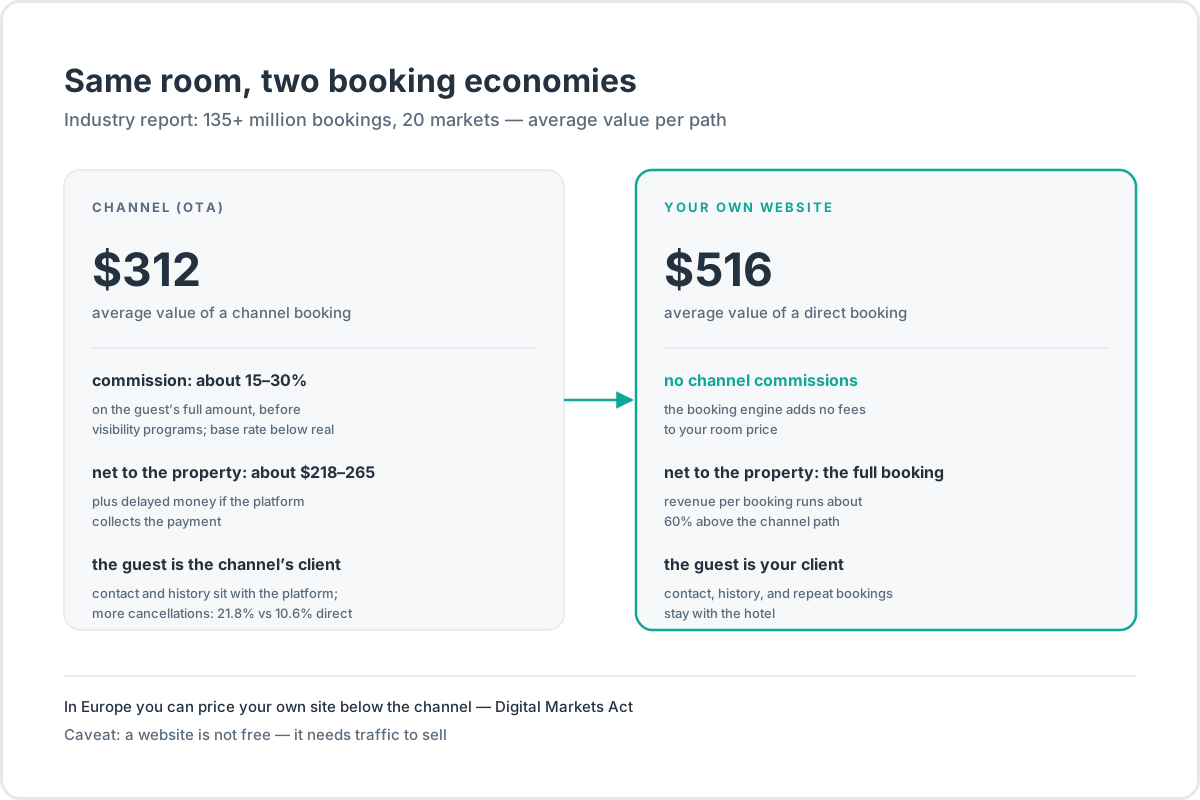
Until recently, the main objection ran: “Booking forbids showing a lower price on your site.” In Europe, that no longer works. Since November 2024, Booking.com, as a designated gatekeeper, has been meeting its Digital Markets Act obligations: rate-parity clauses—clauses demanding a property not display a price below the channel’s—are banned in the European Economic Area, and in December 2024 the platform officially dropped them. A price on your own site lower than the channel’s is legal. One caveat: outside the EEA the old rules apply—open your contract and read the parity clause before you cut the rate.
The site is not free—said honestly. It needs traffic: search visibility, metasearch (where your price sits next to the channel’s and is compared automatically—how that works), content, and a fast booking page. The direct share does not grow on its own: per an industry report, it moved by no more than 1.5 percentage points in a year across 95% of markets. The direct channel is an investment that pays back in booking value and guest data—not a free faucet.
And don’t forget the billboard effect: a channel works as a storefront for direct bookings, too. A guest sees your property in Booking.com or Airbnb results, remembers the name, searches for it, and books on your site. Studies have documented this since 2009—what it means for small hotels and how to check it on your own numbers is covered in a separate article. Presence in the channels and your own site do not compete—they reinforce each other.
Several channels: how not to drown in dashboards
The last question, which everyone somehow leaves for later: how do you run all of this. With the second channel comes a problem with no tidy manual solution—the same room is on sale in two places, and between a booking in one and the date closing in the other there is a window. Double bookings are born exactly in that window: a guest without a room, a walk at the hotel’s expense, a review you cannot delete. The price of reconciling calendars by hand—in the overbooking deep dive.
The answer is an industry standard: a Channel Manager—a layer between the PMS and the channels. One edit goes out—rates, availability, restrictions—and bookings, changes, and cancellations come back, straight into the Planner with a source tag. Connecting starts with a searchable catalog (mature systems carry over a hundred channels: Booking.com, Airbnb, Expedia, and dozens of others), then mapping room types and rates, after which the data uploads itself—two years ahead. The largest vendors count connections in the hundreds—420–450+—but you need your own three to five, not somebody else’s total. How sync works and how to choose a system—in the Channel Manager guide.
A bonus of channel presence that rarely gets noticed: the new storefronts are being built on top of the platforms’ catalogs, not on top of hotel websites. In May 2026, TikTok launched lodging booking inside its app in the US—and lodging gets there only through partner channels: Booking.com, Expedia, Trip.com. There is no direct connection for hotels. The same goes for AI assistants: they recommend hotels from OTA listings. Presence in the channels’ inventory is also presence in storefronts that do not exist yet.
To see how channel management is built in one system—the Channel Manager page.
The bottom line
- A Booking.com alternative is not another “super-channel” but a combination matched to your guests’ geography and your inventory format: in Europe the second tier is Expedia and Airbnb (for apartments); in the US, Expedia first; in Asia, Agoda; in Latin America, Airbnb, Expedia, and the local Despegar.
- Compare commissions by the real rate—after visibility programs, from your statements, not from a landing page. A 15% base easily turns into an effective 17–18%.
- Four questions before connecting: where the guests come from, what the inventory format is, what the real commission is, how many dashboards you can handle.
- Your own website is the best second channel: no channel commission, $516 against $312 per booking, guest data on your side. In Europe, pricing below the channel’s rate has been legal since November 2024.
- Channels and the site reinforce each other: the billboard effect brings guests over from the storefronts, and the new storefronts (TikTok Go, AI search) are built on channel catalogs.
- From the second channel on, you need sync: a Channel Manager keeps rates, availability, and bookings in order—without a daily manual reconciliation.
If you are still assembling a property’s whole system, start with the article on small-hotel software: channels are an important part, but the order “inventory → rates → channels → website” matters more than the list of storefronts.
Frequently asked questions
Which Booking.com alternatives suit a guesthouse or small hotel?
It depends on format and guests. For a classic 9–30 room small hotel in Europe—Expedia as the second channel and your own website as the margin channel. For apartments and guesthouses—Airbnb (in France and Southern Europe it is often the first channel by weight). Guests from Asia—Agoda; from the US—Expedia. A hostel—Hostelworld. The full channel map with profiles—in the OTA article.
How much commission does Airbnb take from a hotel?
For professional listings—hotels, aparthotels, and everyone connected through a PMS or Channel Manager—a single host fee of about 15.5% applies, built into the price. The split model—about 3% from the host plus 14–16% from the guest—is not available to these properties. The guest sees no separate service fee—but Airbnb should be compared with other channels on the full host rate. How a channel commission is calculated on the guest’s full amount—in the OTA article.
Which is better for a small hotel—Airbnb or Booking.com?
It is not a contest; they bring different audiences. Booking.com is strong in classic hotel demand and dominates Europe; Airbnb is strong in lodging with character: apartments, houses, boutiques. If your inventory is standard rooms, Booking will bring more; if you rent apartments or a house with a terrace, Airbnb may become the first channel. Your own data decides: guest geography and the share of formats in the past season—how to read them is covered in the OTA article.
How many sales channels does a small hotel need?
Most often, one or two channels plus your own website is enough. Industry data shows the payoff from each next channel shrinks: after five or six, growth plateaus. Two channels with live listings beat five with stale availability. How to keep several channels in sync without manual reconciliation—in the Channel Manager guide.
Can a hotel work without Booking.com at all?
It can, but that is a strategic decision, not a saving. Channels deliver 63.4% of bookings at independent properties and work as a billboard for direct bookings—the effect has been documented in studies since 2009 (the deep dive). Dropping the biggest storefront makes sense only if you know exactly where the replacement demand comes from: steady direct traffic, groups, a corporate contract. For most small hotels the working formula is Booking.com plus one or two channels plus the website.
How do you manage several channels without double bookings and manual reconciliation?
Through a Channel Manager: rates, availability, and restrictions go out to every channel as one edit, and bookings come back into the Planner automatically, tagged with their source. An honest caveat: double bookings do not vanish entirely—channels can still race one another for the same room, and such a booking goes into processing. The difference is that the conflict becomes a one-off incident instead of a daily lottery. How it is built in the product.