

Notes for hoteliers
The billboard effect: how a presence on OTAs brings direct bookings
Leeloo The First / Pexels
Sunday evening. A guest is planning a trip: opens Booking.com, types in a city and dates, scrolls the results. Between a business hotel by the station and an aparthotel with parking, yours flashes past—fourteen rooms, good photos, a 9.1 rating. The guest looks at the price, at the breakfast photo… and closes the app. Opens a search engine, types the hotel’s name, lands on the site, and books there.
On Monday the owner sees the booking in the Planner with the source “website” and cannot explain where it came from: no search ads running, no newsletter sent, no marketing director hired—because it’s a fourteen-room hotel. An explanation exists, and it is seventeen years old. The guest walked past the channel’s storefront—and the storefront worked. It’s called the billboard effect, and it has fueled more arguments than any other question in distribution: some call it a free source of direct bookings, others a myth debunked back in 2015. Let’s sort out what it actually is, what the research showed, and what a small hotel can do with any of it.
What the billboard effect is, in plain words
The billboard effect is the situation where a hotel’s presence in a sales channel produces bookings not only in the channel itself but also on the hotel’s own site. The guest sees the property in OTA (online travel agency) results, doesn’t book there, but searches the hotel’s name in a search engine and completes the booking directly (how channels work and what their commission is made of—in the separate article). The channel worked like a billboard along the road: it showed the property, and the deal happened somewhere else.
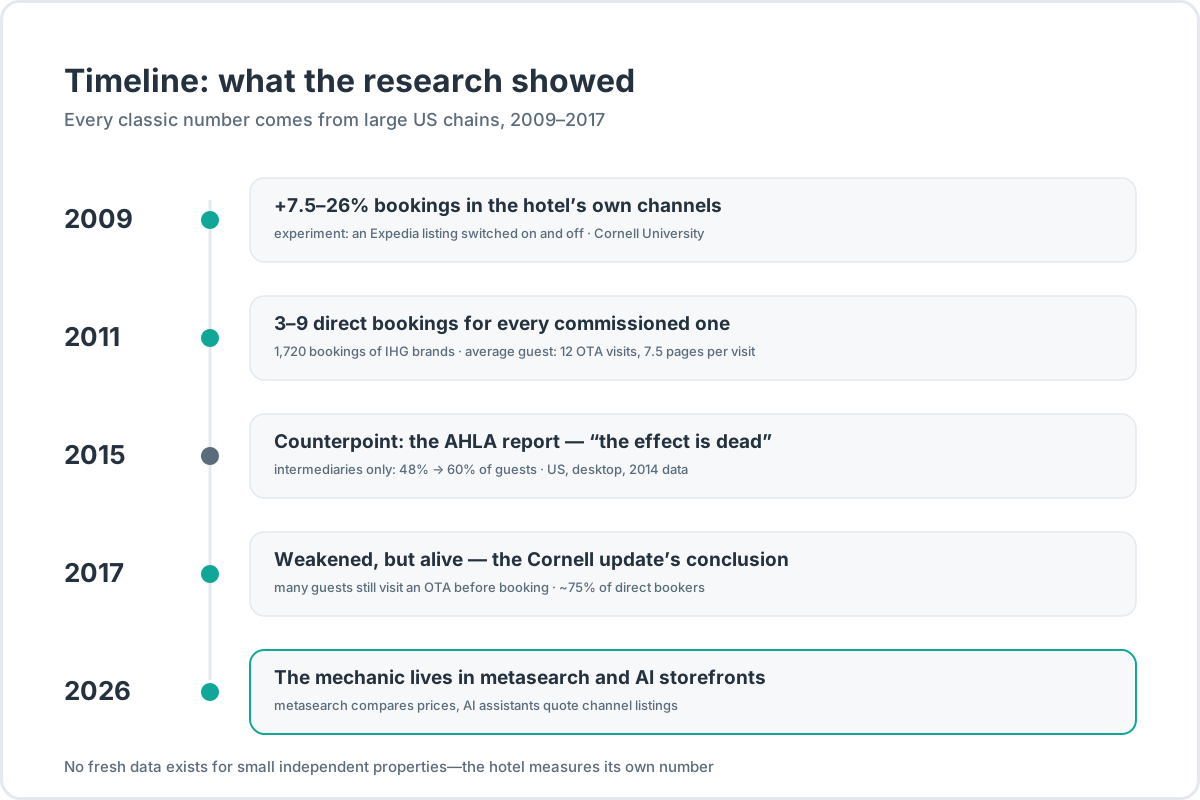
The term was coined by Chris Anderson, a researcher at the Cornell Center for Hospitality Research. In 2009 he ran a simple experiment: four hotels of the JHM Hotels chain in the US were switched on and off on Expedia in turn, while he watched what happened to bookings on their own sites. When the listing was visible, direct bookings grew—by 7.5–26% on top of the bookings Expedia itself delivered. The storefront worked even in the months when the channel brought its own commissioned bookings.
The mechanic looks like this.
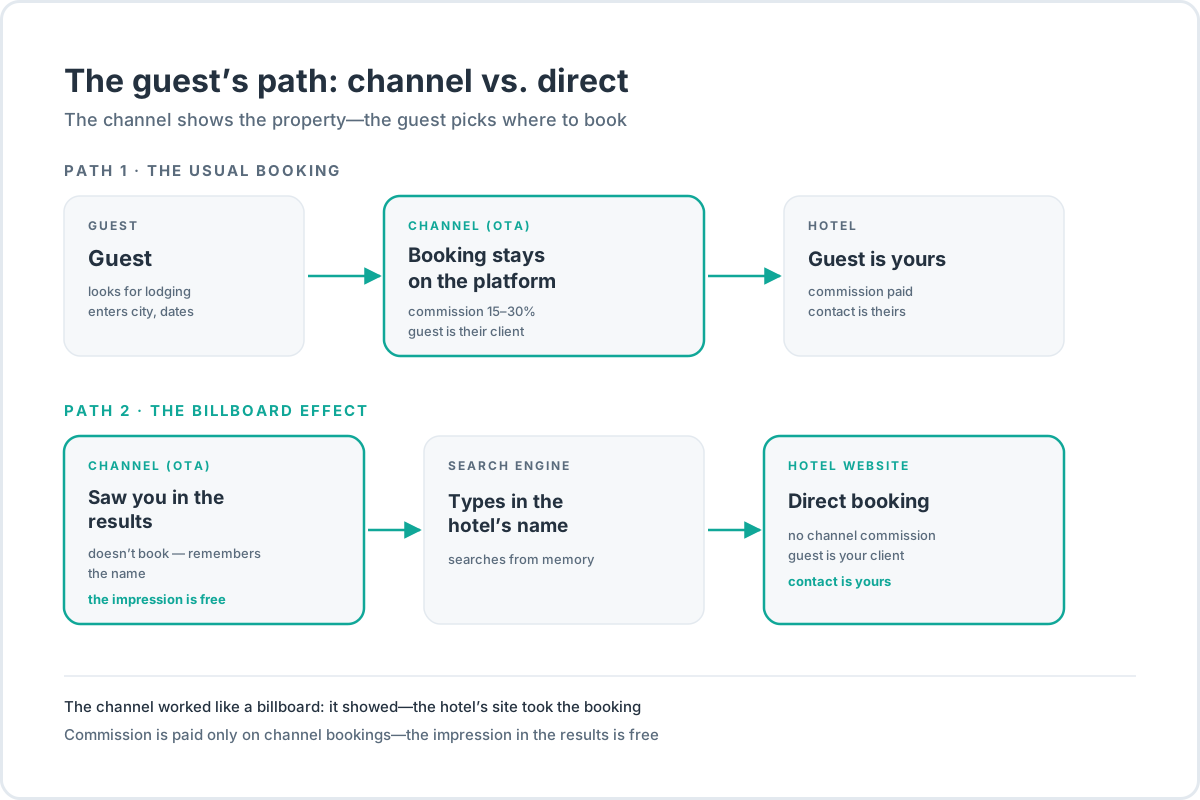
The guest searches for lodging in a channel’s catalog → notices your property among dozens of others → doesn’t book at once, but stores the name in memory → types it into a search engine → lands on the site → books directly. At every step they can drop out of the path: miss the property in the results, fail to find the site, change their mind on an awkward booking page. The billboard is not a switch—it is a set of probabilities. But the direction of the path is exactly this: from the channel’s storefront to the hotel’s site.
And here is what matters for the economics. The channel takes a commission only on the bookings that happened with it. The impression in the results is free: Expedia doesn’t bill you for a guest who saw your property and closed the tab. If some of those viewers then come to the site, the channel worked for them like advertising you didn’t pay for. It doesn’t follow that a channel presence “pays for” its commission by itself—but it belongs in the channel’s overall economics before you write the channel off as a pure cost.
What the research showed: a timeline
The topic has an unusually rich academic biography—by the standards of hotel distribution, nearly a detective story. Three Cornell studies, a counterpoint from a hoteliers’ association, and dozens of rewrites that over fifteen years retold the numbers beyond recognition. Let’s assemble the timeline from the primary sources.
| Year | What was measured | The key number | Caveats |
|---|---|---|---|
| 2009 | Four JHM Hotels properties switched on and off on Expedia in turn (Chris Anderson, Cornell) | Presence in the channel added 7.5–26% bookings in the hotel’s own channels, on top of the channel’s own bookings | US chains; four properties; 2009 |
| 2011 | The expanded analysis: 1,720 bookings of IHG brands over the summer seasons of 2008–2010 (Anderson, Cornell) | For every commissioned Expedia booking there were 3–9 bookings on the brand’s own sites | Large US chains; the desktop era |
| 2015 | The counterpoint: a behavior analysis of ~50,000 US travelers, comparing 2012 and 2014 (P.K. Kannan, University of Maryland; a report commissioned by AHLA) | The share using only intermediaries grew from 48% to 60%; a visit to the hotel’s site more and more often ended in a booking with an intermediary | US chains; desktop only; 2014 data; the sponsor—an association whose members pay OTA commissions |
| 2017 | A repeat analysis of the channel’s power to influence the final booking (Anderson and Han, Cornell) | The influence is weaker, but the effect lives: many guests still visit an OTA before booking; ~75% of those who booked direct had been in a channel beforehand | US; the 75% figure is a retelling of earlier data inside the 2017 paper itself |
Let’s unpack what’s inside these rows—and why retellings usually distort the numbers.
2009: +7.5–26%. In the original study’s abstract, the lower bound is 7.5%. The “9–26%” many people know came later: it’s a retelling from the 2017 update, where the first work is quoted with the number already rounded. We give the figure from the primary source. Its shape matters too: this is growth in the hotel’s own-channel bookings—ones that happened on top of Expedia’s own bookings, not instead of them.
2011: three to nine direct bookings per commissioned one. The most-cited paper of the topic. Sample: 1,720 bookings of IHG brands across three summer seasons. Finding: for every booking the brand paid Expedia a commission on, three to nine bookings arrived on the brand’s own sites. A bonus from the same paper—the portrait of the average “shopper”: 12 OTA visits, 7.5 pages per visit, about five minutes per page. Guests don’t pick a hotel in one sitting; they circle the search results for days, and your property crosses their orbit again and again.
The 75% figure—quote it carefully. In rewrites it lives as “a 2011 study showed that 75% of those who booked on a hotel’s site had been on an OTA first.” The 2011 abstract doesn’t contain it—it appears in the 2017 paper as a summary of earlier data: about 75% of guests who booked with a major US brand had visited an OTA beforehand. You may quote it—but honestly, as an estimate from the 2017 update, not a direct result of 2011.
2017: “weaker, but alive.” Anderson and Han returned to the topic eight years later and worded it carefully: the channel’s power to influence the final booking may be lower, “but the billboard effect still occurs, since many consumers visit an OTA prior to booking.” That is the key finding for today’s owner: the mechanism hasn’t switched off—it has grown weaker and messier. The booking funnel is no longer linear.
2015: the counterpoint. The US hoteliers’ association (AHLA) commissioned an analyst, P.K. Kannan of the University of Maryland: clickstream data on roughly 50,000 American travelers for 2012 and 2014. The findings were harsher: the share of travelers using only intermediaries grew from 48% to 60%, and by 2014 a visit to a hotel’s site more often ended in a booking with an intermediary than a direct one—in 2012 it was the other way around. That summer’s media headlines read “the billboard effect is dead.” The caveats here are substantial: US only, desktop only, 2014 data—and the study’s sponsor is an association whose members pay channel commissions and have a vital interest in the conclusion “direct isn’t growing.” There is no scientific consensus here: one line of research measures the growth in direct bookings from channel presence, another the migration of behavior toward intermediaries. The honest position is to accept both numbers and build a strategy on neither alone.
A separate line—about what the table doesn’t hold. Every classic number comes from large US chains, mostly on desktop traffic, in 2009–2017. No fresh academic study of small independent properties exists. Carrying “7.5–26%” over to a nine-room guesthouse in 2026 is not allowed—you can only test it on your own data, and below is a section on how.
Is the billboard alive today
The “alive or dead” argument is the least useful part of the topic. The better question: where does the mechanic “saw it at an intermediary → booked at the source” live today. And here a decade has changed plenty.
The storefront has multiplied. In 2009 the stage for the effect was OTA search results. Today metasearch stands next to them: Google Hotels, Tripadvisor, and Trivago compare prices from different sources, and the booking completes with whoever’s row the guest picked. It is exactly the same mechanic—“compared → went to the source”—only multiplied and built into Google Search. It has one measurable advantage over the classic billboard: clicks on the free link to your site show up in reports, unlike the guest who silently looked you up on Booking and just as silently googled your name. How metasearch works and how to get into the price comparison with your own row—in the separate article.
Part of the impressions has moved to AI assistants. Per an industry report, 56% of American travelers planning leisure trips use AI tools, and more than 55% of the sources AI assistants cite in hotel recommendations are OTA listings. Translating from vendor-speak: when a guest asks a chatbot where to stay, the bot most often retells channel listings—their descriptions, ratings, and photos. The storefront remained a storefront even when the storefront became a conversation with an AI. The source here is a vendor one (the report is published by a maker of PMSs—property management systems—and channel managers), but the direction it records is right: the guest’s path doesn’t necessarily start at the channel’s site—it starts with the data about it.
Channels have grown more expensive as advertising. The top four OTAs spent more than $20 billion on marketing and sales in 2025 (an estimate from an industry report). For an owner this means one simple thing: a guest searching for a place to stay will almost certainly pass through channel search results—that’s where the money is poured, that’s where price comparison and reviews live. Not showing up there means handing the storefront to the competitors in your neighborhood.
Now fold the argument together. As a guaranteed mechanism from a 2009 brochure—“connect a channel and gain a quarter more direct bookings”—the billboard is dead: the funnel is messier, part of the mechanic has moved to metasearch, and the 2015 counterpoint was never repealed. As a property of the funnel, it lives: guests still browse properties at intermediaries and still reach the sites of those who caught their eye. The wording for a small-hotel owner is this: the billboard is not a source you can switch on—it’s a property you can keep from ruining. An awkward site, drifting prices, and an empty calendar in the channel kill it faster than any trend.
What a small hotel should do: five working tactics
Every tactic below is a market practice, not a setting in some system. Software’s only role is to stay out of the way: keep prices and availability identical across every point of sale.
1. Be where they search for you—but not everywhere
The effect’s starting point is the impression in channel search results. No impression—no commissioned bookings and no billboard. On the other hand, there are dozens of channels, and connecting all of them is a sure way to drown in commissions and sync errors.
A benchmark for the count: three to five channels that match your audience, with a plateau at five or six. An estimate from an industry report, drawn from the vendor’s internal data: going from two channels to three meant on average 70% revenue growth; every next channel added less; past five or six, growth flattened out. The number is a vendor’s—the source sells channel managers—but it matches practical common sense: five channels means five listings you have to keep alive. Choose by geography and guest type: Booking.com and Airbnb cover most small properties; beyond them, local and niche channels for your format.
2. Upgrade the listing—so there is something to remember
The billboard only fires if the guest noticed the property and remembered its name. The same things decide it as decide your position in the results: the first photo, complete amenities, a live description, the rating and the reviews. A half-filled listing doesn’t work as a billboard—guests scroll past it without reading the name. How exactly Booking.com and Airbnb rank properties, and what in a listing drives impressions—in the OTA algorithm walkthrough.
The property’s name belongs here too. The guest will type it into a search engine from memory. “Cozy Hotel 3” searches worse than a distinctive name; and if your name matches a chain brand, the guest risks landing on someone else’s site. Test it yourself: type your property’s name into mobile search and see what comes up on top.
3. A site that finishes the booking
A broken billboard looks like this: the guest saw the property in a channel, googled it, landed on the site—and didn’t book. The channel’s impression worked for nothing, and the owner concludes “the billboard doesn’t work,” when it’s the booking page that doesn’t work.
What to check first: the site opens on a phone in a couple of seconds; the booking completes in two or three clicks, no account creation; the price on the site is no higher than the channel’s—a gap sends the guest back to the channel and the whole path loops; card payment works online. Keeping prices convergent by hand is thankless work: edits should leave for all channels from a single calendar—that is the mechanics of the Channel Manager. And the booking page itself is placed on the site by the Booking Engine—it embeds with two lines of code; how to choose one for a small property is covered in the separate guide.
4. A reason to book direct—and it isn’t a discount
The classic mistake: fighting for direct bookings by undercutting prices on your own site. Cheaper doesn’t mean more convincing—and in some jurisdictions it is also questionable under rate parity agreements. Other levers work—the things a channel cannot give in principle:
- softer cancellation terms for direct bookings—the very thing guests leave OTAs for;
- breakfast or late check-in included only in a direct booking;
- a room-type upgrade when rooms are free;
- a deposit or prepayment smaller than the channel demands—flexibility an intermediary doesn’t have.
The point is one: a direct booking must give the guest a tangible benefit without wrecking the room’s economics. A discount cuts the margin for every guest at once; a bonus costs the hotel only when the guest uses it.
5. Availability tilted toward the site—carefully
The market tactic of this family: show fewer rooms in the channel than you have, holding some back for direct bookings. Technically these are quotas—limits on sellable dates per channel, created and synchronized by the Channel Manager.
Two warnings. First: zeros and closed dates cut impressions in the channel’s results—a billboard must not be left an empty showcase; the platform’s algorithms read a closed calendar as a dead property. Second: don’t confuse it with the reverse tactic—deliberate overselling of inventory, when channels sell more than exists in expectation of no-shows. That is a separate strategy with its own price of errors—in the article on overbooking. And the honest frame: restricting availability is a market distribution practice, not a function of any system; what decides in the end is not the cunning of quotas but the quality of the listing and the booking page.
How to test the effect on your property
Anderson called the topic’s central difficulty the attribution puzzle: a direct booking that arrived by the billboard path is invisible in the channel’s reports—the channel honestly shows only its own, commissioned bookings. Hence the old parable of the blind men and the elephant: one owner sees direct bookings grow after connecting a channel and believes in the billboard; another sees nothing and doesn’t.
The classic method from the 2017 study is an experiment: switch the channel (or a paid campaign in it) off for a short period and compare direct booking volume before and after. The method works, but for a small property it hurts: a switched-off channel also means lost commissioned bookings. There are cheaper ways:
- the booking source field. Bookings from channels land in the Planner with a source label—the commission side of the ledger is visible at once. Direct bookings carry no source; their share of occupancy is counted from the Planner or a bookings export;
- the question at check-in. “How did you hear about us?”—thirty seconds of talk at the desk, zero spent on analytics. The answer “saw you on Booking, booked here” is your billboard in its pure form;
- a direct-only bonus. A promo code or a breakfast mentioned only on the site works as a marker: the ones who use it are those who reached a direct booking—and the usage count shows how many guests walked the path to the end;
- link tags. If you do run paid traffic to the site, tag your links—then the statistics show which visits came after a look at the channel.
These techniques won’t give you the exact number of direct bookings a channel brings—nobody gives that: there is no fresh research on small properties, and carrying American numbers from 2009 over to yours is not advisable. But the direction—whether direct bookings grow with a live listing in the channel or not—can be seen, and that is enough to decide where to keep the storefront.
How this looks in HotelsCalendar
Start with the frame: the billboard effect is a market phenomenon, not a product function. No software “switches it on” or promises direct booking growth—nobody can guarantee other people’s guests. What software can do is not break the guest’s path on its last two steps: from the channel’s storefront to a booking in the Planner.
Step one—prices and availability. The Channel Manager computes quotas from the single PMS calendar: close a date, and quotas zero out in every channel; change a rate, and the change goes out on its own. The guest comparing your site with the channel’s results sees converging prices—not a reason to go back to the intermediary.
Step two—the booking page. The Booking Engine embeds into a site with two lines of code; the guest books in three clicks; card payments run through Stripe. A booking from the site lands in the PMS Planner on its own, with no manual re-entry, and your software bill is the subscription alone: no commission on bookings. From there the effect is the market’s to make: some of the guests who saw you in the channel reach the site—and the site doesn’t fall apart on them halfway.
What we don’t do—and don’t promise: no guarantees of direct booking growth, no “managing” the billboard, no selling visibility in channels—impressions are decided by the platforms themselves. Our part is humbler and more honest: the channel storefront and the booking page say the same thing, in one language of prices, availability, and rates. The rest—the Booking Engine and the Channel Manager on their own pages.
The takeaway
- The billboard effect—a hotel’s presence in a channel brings direct bookings: the guest sees the property in OTA results, searches its name, and books on the site. The impression in the channel is free—commission is paid only on the channel’s own bookings.
- The research: 2009—7.5–26% more own-channel bookings with a live Expedia listing; 2011—three to nine direct bookings per commissioned one; 2017—the influence is weaker, but the mechanic lives. All numbers are large US chains; there is no fresh data for small properties.
- The counterpoint—the 2015 report commissioned by AHLA: guest behavior shifted toward intermediaries. There is no scientific consensus—build decisions on your own data, not on someone else’s averages.
- Today part of the mechanic has moved to metasearch and AI storefronts: guests compare prices in Google and ask chatbots for advice, and the bots quote channel listings. There are more storefronts now, not fewer.
- The tactics: three to five relevant channels, a live listing with a memorable name, a site that books in two or three clicks with converging prices, bonuses for direct bookings instead of discounts, careful quotas without an empty storefront.
- Testing—by hand: the source field on bookings, the question at check-in, a marker bonus for direct bookings. The attribution puzzle doesn’t solve itself elegantly, but the direction can be seen.
Frequently asked questions
What is the billboard effect at a hotel, in plain words?
The guest searches for a place to stay, scrolls a channel, notices your property—and doesn’t book there. They google the hotel’s name and book on the site. The channel worked like a billboard: it showed, and the site took the booking. The term was coined by Chris Anderson in a 2009 Cornell University study. The channel takes a commission only on bookings that happened with it—the impression on someone else’s storefront is free. How sales channels themselves work—in the article about OTAs.
Does the billboard effect still work, or is it dead?
As a guaranteed mechanism, it has weakened: in the 2017 update the authors themselves write that a channel’s influence on the final booking is lower than before, and the 2015 report commissioned by the US hoteliers’ association found no effect at all. As a property of the funnel, it lives: many guests still visit channels before booking, and part of the mechanic has moved to metasearch and AI assistants. The honest conclusion: this is not a source of direct bookings you can switch on, but a property worth not ruining—where the mechanic has moved is covered in the article on metasearch.
How many direct bookings does a presence on Booking.com bring?
There are no exact fresh numbers—and that is the honest answer. The classic measurements: 2009, four US hotels on Expedia—7.5–26% more own-channel bookings; 2011, the IHG chains—three to nine direct bookings per commissioned one. All the data is large US chains, 2009–2017; you can’t carry the numbers over to a small property as-is. Your own number can be measured: from the source field on bookings and a question to guests at check-in. How to count the channels’ share of occupancy—in the Channel Manager guide.
A guest saw the hotel on Booking, went to the site—and booking there is awkward. What’s wrong?
It’s not the billboard that’s broken—it’s the site’s conversion. Check: the page opens on a phone in a couple of seconds; the booking completes in two or three clicks without registration; the price is no higher than the channel’s—a gap sends the guest back to the channel; card payment works online. The booking page is placed on the site by the Booking Engine—it embeds with two lines of code; how to choose one for a small property is covered in the guide.
Can I show fewer rooms in the channel than I have, holding some back for direct bookings?
Technically these are quotas—limits on sellable dates per channel; they are created and synchronized by the Channel Manager. Two “buts”: zeros and closed dates cut impressions in the channel’s results—the storefront must not stand empty; and don’t confuse this with deliberate overselling of inventory—a separate strategy with its own price of errors, in the article on overbooking. What decides in the end is not the cunning of quotas but the quality of the listing and the booking page.
What matters more for the billboard—the listing in the channel or the hotel’s site?
Both ends of the path. The listing decides whether guests remember you and find you by name: photos, description, rating, position in the results. The site decides where the guest finishes the booking: without a booking page, the channel’s impression works for the channel. Between them lives metasearch—the modern form of the same “compared → booked at the source” mechanic. What drives impressions in channel results—in the OTA algorithm walkthrough.